Seller-Server Training
Welcome to the Seller-Server Training course
for the state of Texas presented by
Alcohol Compliance Educational Services, Inc.
BEFORE WE BEGIN:
This course is designed to run within a web browser. Every effort has been made to ensure mobile friendliness. If you experience any issues with the training course, or with any part of our website, please reach out to use through our contact form or email us at WebSupport@tabc-training.com
This course is set up like a slide show with audio. It will advance automatically after the audio clip plays. Please note that there are parts of this course that will require interaction with the participant and you will not be able to complete it without the required interactivity.
Please click the play button to begin.
Introduction
This course curriculum meets the requirements of the Texas Alcoholic Beverage Commission (TABC) Administrative Rules §50.3. The curriculum covers the laws regulating the sale or service of alcoholic beverages to minors, intoxicated persons, and non-members of a private club. It also teaches techniques to identify these persons and prevent sales to them.
Introduction: Curriculum Goals
The TABC strongly feels that trained sellers, servers, and managers are better able to identify and prevent sales of alcoholic beverages to minors, intoxicated persons, and non-members of a private club.
This curriculum is designed to meet the needs of employees that sell, serve, dispense, or deliver alcoholic beverages under the authority of a license or permit, including persons who immediately manage, direct, supervise, or control the sale or service of alcoholic beverages.
Our goal is to train the individuals taking this class so that they understand their responsibilities as sellers, servers, and managers, and know techniques to carry out those responsibilities.
Introduction: Course Objectives and Sequence
Module 1: TABC Seller-Server Training Overview
After completing this module, the trainee will be able to do the following:
- Correctly define terms used in this course.
- Describe the purpose, goals, and rules for seller-server training and certification.
- State the intent of Texas laws concerned with preventing alcohol sales to minors, intoxicated persons, and non-members of a private club.
Introduction: Course Objectives and Sequence
Module 2: Minors and Alcohol Sales
After completing this module, the trainee will be able to do the following:
- Given a scenario, state if a sale of alcohol is legal or illegal with regards to minors.
- Use observations to detect that a minor is attempting to purchase alcohol.
- Correctly identify if an Identification (ID) is valid and proper for purposes of establishing age.
- Recall that the possession, use, manufacture, or misuse of an ID is an illegal act.
- Given a scenario, select appropriate intervention techniques in regards to a minor attempting to purchase alcohol.
Introduction: Course Objectives and Sequence
Module 3: Intoxicated Persons and Alcohol Sales
After completing this module, the trainee will be able to do the following:
- Describe how seller-servers are responsible for the acts of their customers (Dram Shop Act).
- Given a scenario, state if a sale of alcohol is legal or illegal with regards to an intoxicated person.
- Define blood alcohol concentration (BAC) and list factors that affect BAC in individuals.
- Identify behaviors that could indicate if a person is intoxicated.
- Given a scenario, select appropriate intervention techniques for intoxicated persons.
Introduction: Course Objectives and Sequence
Module 4: Alcohol To-Go, Delivery and Other Permits
After completing this module, the trainee will be able to do the following:
- Identify the requirements for selling an alcoholic beverage for delivery and and to-go orders
- How to properly check and document identification for delivery orders containing alcoholic beverages
- Recall that there are private club rules for serving members and non-members.
Introduction: Assessment
- At the conclusion of the training program, there will be a test. A student must correctly answer at least 70 percent of the questions asked on the final exam to pass. If you pass the final exam, you will be able to print a certificate which show that you took the class and passed the exam.
- You will have one additional opportunity to pass the exam if you do not make at least a 70 on the first attempt.
- We will be responsible for documenting the final exam results and reporting results to the commission.
Module 1: Seller-Server Training Overview
Module Objectives
When you complete this module, you will be able to:
- Correctly define terms used in this course.
- Describe the purpose, goals, and rules for seller-server training and certification.
- State the intent of Texas laws concerned with preventing alcohol sales to minors, intoxicated persons, and non-members of a private club.
Module 1: Seller-Server Training Overview
Topics in this module
- Keys To This Course
- Definitions
- Responsibilities of Seller-Server
- Safe Harbor for Employers
- Seller-Server Certification
Module 1: Seller-Server Training Overview
Keys To This Course
Knowing the law is an important first step in being a responsible seller-server of alcoholic beverages. In order to be a responsible seller-server of alcohol, you will need to know:
- Know the Law
- Know your Customers
- Know How and When to say "No".
Module 1: Seller-Server Training Overview
Keys To This Course
There are laws regulating the sale of alcohol in order to
- Prevent the sale of alcohol to minors under 21 years of age.
- Prevent the sale of alcohol to people who are intoxicated.
- Prevent the service of alcoholic beverages in private clubs to non-members
Module 1: Seller-Server Training Overview
Keys To This Course
When customers purchase alcoholic beverages from you, you are the one to decide whether the sale is legal or not, based on your observations. This class will teach you key things to look for. To decide if a sale of alcohol is legal, watch your customers to:
- See How They Look
- See What They Do
- See How They React
- See How Much Alcohol Has Been Purchased or Consumed
Module 1: Seller-Server Training Overview
Keys To This Course
Intervention means refusing a sale of alcohol to an individual in order to remain lawful. Customers purchase alcohol from you, and you are the one that must ensure the sale is legal. This class will teach you intervention methods.
Module 1: Seller-Server Training Overview
Keys To This Course
WHAT ARE THE KEYS TO INTERVENTION?
In order to prevent an illegal sale of alcohol, you need to :
- Be Quick
- Be Clear and Firm
- Be Consistent
Module 1: Seller-Server Training Overview
Seller-Server Certification
All seller-server schools are private businesses separate from the TABC. These schools are regulated by the Texas Alcoholic Beverage Commission and have been approved as meeting the minimum requirements as stated in Chapter 50 of the TABC Administrative Rules and the Texas Alcoholic Beverage Code.
You should receive a certificate immediately following the successful completion of this course and your certificate should be available within 14 days in the TABC database.
Module 1: Seller-Server Training Overview
Seller-Server Certification
-
Training programs are monitored by the Commission to determine if the schools are presenting the programs as approved and certified by TABC. If you have a complaint about a seller training school, contact TABC Seller Training at (512) 206-3420 or your local TABC office.
-
If you need to report underage drinking or suspected sales to intoxicated persons, call 1-888-THE-TABC.
Module 1: Seller-Server Training Overview
Seller-Server Certification
The seller-server training includes some information that you provided at the beginning of the course as well as this school’s information. This information will be entered into the TABC seller-server database no later than 14 calendar days from today. You must provide complete information to receive a certificate: name, personal identification number (Social Security Number, Individual Taxpayer Identification Number [ITIN], an Alien Registration Number [“A” Number], or an IV case number from a machine readable immigrant Visa [MRIV]), and date of birth. Once you receive the certificate, it is suggested that you make a copy of it for your employer and keep the original for yourself. The certification belongs to you, no matter who pays for the course.
NOTE: Your personal information is for this course and TABC’s files only; it may not be sold or used for any other purpose.
Seller-server certification is valid for two years unless earlier revoked. If you want to remain certified, you must take the class and exam again on or before the expiration date on your certificate. If you lose or misplace your certificate, you can receive proof of certification from the TABC website at www.tabc.state.tx.us or by calling the TABC Seller-Server Training Section at 512-206-3420.
Module 1: Seller-Server Training Overview
Definitions
Alcoholic Beverage
An alcoholic beverage is alcohol, or any beverage containing more than one-half of one percent of alcohol by volume, which is capable of use for beverage purposes, either alone or when diluted. [Texas Alcoholic Beverage Code Sec. 1.04 (1)]
Alcoholic beverages may be sold by the drink for on-premise consumption in establishments such as restaurants and bars. Depending on permit type, alcoholic beverages can be sold “To-Go” from an on-premise location to be consumed off the licensed premises.
Alcoholic beverages are also sold packaged for off-premise consumption in establishments such as convenience stores, gas stations, grocery stores, or liquor stores.
Module 1: Seller-Server Training Overview
Definitions
Alcoholic Beverage
Common alcoholic beverages include:
- Beer
- Malt liquor
- Wine
- Wine coolers
- Distilled Spirits
- Mixed drinks
- Cocktails
Module 1: Seller-Server Training Overview
Definitions
Employee
Anyone who sells, serves, dispenses, or delivers alcoholic beverages for a business that is licensed to sell alcohol is considered an employee of that business. This also includes anyone who immediately manages, directs, supervises, or controls the sale or service of alcoholic beverages. (Employee does not include officers of a corporate permittee/licensee who do not manage, direct, supervise, or control the sale or service of alcoholic beverages.) [Texas Alcoholic Beverage Commission Administrative Rules Sec. 50.2 (4)]
Module 1: Seller-Server Training Overview
Definitions
Minor
A person under the age of 21. [Texas Alcoholic Beverage Code Sec. 106.01]
Intoxication
Not having the normal use of mental or physical faculties by reason of the introduction of alcohol, a controlled substance, a drug, a dangerous drug, a combination of two or more of those substances, or any other substance into the body, or having an alcohol concentration of 0.08 or more. [Penal Code Sec. 49.01]
Module 1: Seller-Server Training Overview
Definitions
Public Intoxication
To appear in a public place while intoxicated to the degree that the person may endanger the person or another. [Penal Code Sec. 49.02]
Criminal Negligence
A person fails to meet a standard level of care that an ordinary person under these conditions would meet, e.g. checking IDs, calculating age, refusing to over-serve patrons, and looking for signs of intoxication. [Penal Code Sec 6.03]
Module 1: Seller-Server Training Overview
Responsibilities of a Seller-Server
The most important responsibility of a Seller-Server is to follow the laws intended to prevent the sale of alcohol to minors, intoxicated persons, and non-members of a private club.
The person who actually serves, sells, or delivers the alcoholic beverage is legally responsible for the sale.
Door people, bouncers, floorwalkers, or bartenders can assist with checking IDs and monitoring for intoxication, but the server is legally responsible and will be the one who receives a violation!
Module 1: Seller-Server Training Overview
Responsibilities of a Seller-Server
Breaking the laws for selling alcohol puts you, your employer, and your customers at risk.
- If you knowingly break the laws governing alcohol sales, you may be found guilty of a crime, and you may be found responsible for any damage caused by people to whom you sold or served alcohol.
- The employer is at risk because they could lose their license to sell alcohol.
- The customer is at risk because they may be violating the law by purchasing alcohol.
Module 1: Seller-Server Training Overview
Revocation of Certification Key points
If you are charged with breaking the laws concerning the sale of alcohol, your seller-server certification can be revoked.
- First offense – you must take this class and exam again to be recertified within the first 30 days after the offense.
- Second offense within 12 months – you may not be recertified for 90 days.
- Third offense in 12 months – you may not be recertified for 12 months.
Your seller-server certificate can also be revoked by TABC if you:
- Provide false information.
- Do not successfully pass the final exam.
- If you receive a violation, you can request a hearing within 21 days of the violation.
Module 1: Seller-Server Training Overview
Safe Harbor for Employers Key Points
If you are charged with selling alcohol to a minor or to an intoxicated person, your employer could lose their license to sell. In order for your employers license to be protected:
- The person selling/serving is not the owner or an officer of the company;
- The person selling/serving holds a current seller-server training certificate from a TABC approved school;
- All employees engaged in the sale, service, or delivery of alcoholic beverages, as well as their immediate managers, are certified within 30 days of their hire date;
- The employer has written policies for responsible alcohol service and consumption and ensures that each employee has read and understands these policies;
- The employer does not directly or indirectly encourage the employee to violate the law;
Module 1: Seller-Server Training Overview
Safe Harbor for Employers Key Points
Meeting these criteria is commonly referred to as "safe harbor." If an illegal sale is made, the seller-server might be arrested, but the company's permit/license may be protected.
If one violation takes place:
- Criminal action may be taken against the employee;
- The owner or manager may be required to complete an affidavit stating that they have met all the requirements;
- The owner or manager will be required to provide the names, social security numbers, and dates of birth of all employees so that the affidavit can be verified.
- TABC will verify the certification of the employees.
- If any one of these elements is missing, the company is not protected.
[Texas Alcoholic Beverage Commission Administrative Rules, §34.4.]
Module 1: Seller-Server Training Overview
MODULE 1 REVIEW
This module covered an overview of this seller-serve program including requirements by the TABC, defining common terms and introducing key concepts of seller-server training. Please click the button below for a short true/false quiz based on module one.
Module 2: Minors and Alcohol Sales
Module Objectives
When you complete this module, you will be able to:
- Given a scenario, state if a sale of alcohol is legal or illegal with regards to a minor.
- Use observations to detect that a minor is attempting to purchase alcohol.
- Correctly identify if an ID is valid and proper for purposes of establishing age.
- Recall that possession, use, manufacture, or misuse of an ID is an illegal act.
- Given a scenario, select appropriate intervention techniques with regards to a minor attempting to purchase alcohol.
Module 2: Minors and Alcohol Sales
Topics in this module
Key #1: Know the Law
Key #2: Use Observations to Know Your Customers
- Checking Identification
Key #3: Know When and How to Say "No"
Module 2: Minors and Alcohol Sales
Key # 1: Know the Law
One of the most important jobs you will do as a seller or server of alcoholic beverages is to prevent illegal sales to minors.
It is important to know what is illegal with regards to selling or serving alcohol to minors. This section outlines what the law says, what is legal or illegal for minors, and what is legal or illegal for you to do.
Module 2: Minors and Alcohol Sales
Key # 1: Know the Law
Laws about Minors and Alcohol
The Alcoholic Beverage Code defines a minor as a person under the age of 21. It is a criminal offense for a minor to purchase, possess, attempt to purchase or consume alcoholic beverages.
There are some general exceptions to these laws, such as:
- A minor may possess alcohol in the scope of employment;
- A minor may possess/consume alcohol when in the visible presence of his legal aged parent, legal guardian or spouse;
Module 2: Minors and Alcohol Sales
Key # 1: Know the Law
Laws about Minors and Alcohol
- A minor may possess/purchase/attempt to purchase alcohol when assisting a police officer in the enforcement of the alcoholic beverage code (Minor Sting Operations); and
- A minor may taste alcoholic beverages if they are a student enrolled in certain college courses of study and the minor must spit out the alcoholic beverage. The minor may only taste that alcohol and may not swallow the beverage.
Module 2: Minors and Alcohol Sales
Key # 1: Know the Law
Laws about Minors and Alcohol
A person under 18 may work as a cashier for transactions involving the sale of alcohol if it's for on-premise consumption and served by a person 18 years old or older and the business gets less than 50% of gross receipts from alcohol.
Module 2: Minors and Alcohol Sales
Key # 1: Know the Law
Codes and Rules
CHAPTER 106. PROVISIONS RELATING TO AGE
What it Means
Although it is true that for some things people 18 or over are adults, but when it comes to laws about alcoholic beverages, people under the age of 21 are minors. With some exceptions that we will cover later, the minimum legal age to purchase, possess, or consume an alcoholic beverage is 21 years of age or older.
Module 2: Minors and Alcohol Sales
Key # 1: Know the Law
Codes and Rules
CHAPTER 106. PROVISIONS RELATING TO AGE
Sec. 106.02. PURCHASE OF ALCOHOL BY A MINOR
Sec. 106.025. ATTEMPT TO PURCHASE ALCOHOL BY A MINOR
What it Means
It is illegal for a minor to purchase or attempt to purchase an alcoholic beverage. The exception is if the minor is under the supervision of a peace officer during a sting operation, he will not be charged with an offense.
Sec.106.071 for punishments is explained later in this presentation.
Module 2: Minors and Alcohol Sales
Key # 1: Know the Law
Codes and Rules
CHAPTER 106. PROVISIONS RELATING TO AGE
Sec.106.04. CONSUMPTION OF ALCOHOL BY A MINOR
What it Means
It is illegal for a minor to drink alcoholic beverages. The exception is if the minor is in the visible presence of the minor’s adult parent, guardian, or spouse.
Module 2: Minors and Alcohol Sales
Key # 1: Know the Law Codes and Rules
CHAPTER 106. PROVISIONS RELATING TO AGE
Sec. 106.05. POSSESSION OF ALCOHOL BY A MINOR
What it Means
It is illegal for a minor to possess alcoholic beverages unless they are:
-
Legally serving or selling the alcohol as an employee.
-
In the visible presence of their adult parent, guardian, or spouse.
-
Under the supervision of a commissioned peace officer enforcing this code (in a sting operation).
Module 2: Minors and Alcohol Sales
Key # 1: Know the Law
Codes and Rules
CHAPTER 106. PROVISIONS RELATING TO AGE
Section 106.16 EXCEPTION FOR CERTAIN COURSE WORK
- In this section :
- "Career school or college" has the meaning assigned by Section 132.001, Education Code.
- "Taste" means to draw a beverage into the mouth without swallowing or otherwise consuming the beverage.
Module 2: Minors and Alcohol Sales
Key # 1: Know the Law
Codes and Rules
CHAPTER 106. PROVISIONS RELATING TO AGE
Section 106.16 EXCEPTION FOR CERTAIN COURSE WORK
What it Means
A minor may taste an alcoholic beverage if the minor is at least 18 years old and is enrolled as a student at a public or private institution of higher education or a career school or college that offers a program in culinary arts, viticulture, enology or wine technology, brewing or beer technology or distilled spirits production or technology.
Module 2: Minors and Alcohol Sales
Key # 1: Know the Law
Codes and Rules
CHAPTER 106. PROVISIONS RELATING TO AGE
Section 106.16 EXCEPTION FOR CERTAIN COURSE WORK
What it Means
Note. The beverage must be tasted for education purposes as part of the curriculum for the course, the beverage may not be purchased by the minor; and the service and tasting of the beverage is supervised by a faculty or staff member who is at least 21 years of age.
Module 2: Minors and Alcohol Sales
Key # 1: Know the Law Codes and Rules
CHAPTER 106. PROVISIONS RELATING TO AGE
Section 106.07. MISREPRESENTATION OF AGE BY A MINOR
- A minor commits an offense if he falsely states that he is 21 years of age or older or presents any document that indicates he is 21 years of age or older to a person engaged in selling or serving alcoholic beverages.
- An offense under this section is punishable as provided by Section 106.071.
Module 2: Minors and Alcohol Sales
Key # 1: Know the Law Codes and Rules
CHAPTER 106. PROVISIONS RELATING TO AGE
Section 106.07. MISREPRESENTATION OF AGE BY A MINOR
What it Means
It is illegal for a minor to falsely state that he is 21 years of age or older, or use a fake ID.
Module 2: Minors and Alcohol Sales
Key # 1: Know the Law Codes and Rules
CHAPTER 106. PROVISIONS RELATING TO AGE
Discussion Question
In a case where a minor uses a fake ID, purchases, and then drinks alcoholic beverages, how many different sections of the law have they violated?
Module 2: Minors and Alcohol Sales
Key # 1: Know the Law Codes and Rules
CHAPTER 106. PROVISIONS RELATING TO AGE
Discussion Question
In a case where a minor uses a fake ID, purchases, and then drinks alcoholic beverages, how many different sections of the law have they violated?
There are 4 possible violations:
- 1. Possession of a fake ID.
- 2. Misrepresentation of Age by a Minor.
- 3. Purchase of Alcohol by a Minor.
- 4. Consumption of Alcohol by a Minor.
Module 2: Minors and Alcohol Sales
Key # 1: Know the Law Codes and Rules
CHAPTER 106. PROVISIONS RELATING TO AGE
Discussion Question
Is there an exception to the law that allows a minor to handle alcoholic beverages?
Module 2: Minors and Alcohol Sales
Key # 1: Know the Law Codes and Rules
CHAPTER 106. PROVISIONS RELATING TO AGE
Discussion Question
Is there an exception to the law that allows a minor to handle alcoholic beverages?
Yes. A minor may possess an alcoholic beverage in the course of employment.
Module 2: Minors and Alcohol Sales
Key # 1: Know the Law Codes and Rules
CHAPTER 106. PROVISIONS RELATING TO AGE
Sec. 106.071. PUNISHMENT FOR ALCOHOL-RELATED OFFENSE BY MINOR
This section applies to an offense under Section 106.02, 106.025, 106.04, 106.05, or 106.07.
- Except as provided by Subsection (c), an offense to which this section applies is a Class C misdemeanor.
(1) the court shall order a minor placed on deferred disposition for or convicted of an offense to which this section applies to perform community service for:
Module 2: Minors and Alcohol Sales
Key # 1: Know the Law Codes and Rules
CHAPTER 106. PROVISIONS RELATING TO AGE
Sec. 106.071. PUNISHMENT FOR ALCOHOL-RELATED OFFENSE BY MINOR
- not less than eight or more than 12 hours, if the minor has not been previously convicted of an offense to which this section applies; or
- not less than 20 or more than 40 hours, if the minor has been previously convicted once of an offense to which this section applies
Module 2: Minors and Alcohol Sales
Key # 1: Know the Law Codes and Rules
CHAPTER 106. PROVISIONS RELATING TO AGE
Sec. 106.071. PUNISHMENT FOR ALCOHOL-RELATED OFFENSE BY MINOR
(2) the court shall order the Department of Public Safety to suspend the driver's license or permit of a minor convicted of an offense to which this section applies or, if the minor does not have a driver's license or permit, to deny the issuance of a driver's license or permit for:
(a) 30 days, if the minor has not been previously convicted of an offense to which this section applies;
(b) 60 days, if the minor has been previously convicted once of an offense to which this section applies; or
(c) 180 days, if the minor has been previously convicted twice or more of an offense to which this section applies.
Module 2: Minors and Alcohol Sales
Key # 1: Know the Law Codes and Rules
CHAPTER 106. PROVISIONS RELATING TO AGE
Sec. 106.071. PUNISHMENT FOR ALCOHOL-RELATED OFFENSE BY MINOR
What it Means
-
A minor charged with any of these offenses can be charged with a Class C misdemeanor.
-
First and Second Offense (Class C Misdemeanor) punishments include:
-
A fine up to $500
-
Required attendance at an Alcoholic Awareness Course
-
8–40 hours of community service
-
30–180 days driver’s license suspension
Module 2: Minors and Alcohol Sales
Key # 1: Know the Law Codes and Rules
CHAPTER 106. PROVISIONS RELATING TO AGE
Sec. 106.071. PUNISHMENT FOR ALCOHOL-RELATED OFFENSE BY MINOR
What it Means
-
Third Offense for Minors 17 and older is a Class “B” Misdemeanor. Punishments include:
-
A fine of $250 to $2,000 and/or up to 180 days in jail
-
Possible attendance with parent or guardian at an Alcoholic Awareness course
-
20–40 hours of community service
-
180 days driver's license suspension
Module 2: Minors and Alcohol Sales
Key # 1: Know the Law Codes and Rules
CHAPTER 106. PROVISIONS RELATING TO AGE
What it Means
If the minor does not have a driver's license or permit, the Dept. of Public Safety shall deny the issuance of a driver's license or permit for:
-
(A) 30 days, if the minor has not been previously convicted of an offense to which this section applies;
-
(B) 60 days, if the minor has been previously convicted once of an offense to which this section applies; or
-
(C) 180 days, if the minor has been previously convicted twice or more of an offense to which this section applies.
Module 2: Minors and Alcohol Sales
Key # 1: Know the Law Codes and Rules
CHAPTER 106. PROVISIONS RELATING TO AGE
REVIEW
When it comes to laws about alcoholic beverages, at what age is a person no longer a minor?
Module 2: Minors and Alcohol Sales
Key # 1: Know the Law Codes and Rules
CHAPTER 106. PROVISIONS RELATING TO AGE
REVIEW
When it comes to laws about alcoholic beverages, at what age is a person no longer a minor?
A person is no longer a minor when they are 21 years of age or older.
Module 2: Minors and Alcohol Sales
Key # 1: Know the Law Codes and Rules
CHAPTER 106. PROVISIONS RELATING TO AGE
REVIEW
It is generally illegal for a minor to purchase, attempt to purchase, possess, or consume alcohol. There are a few exceptions. What are they?
Module 2: Minors and Alcohol Sales
Key # 1: Know the Law Codes and Rules
CHAPTER 106. PROVISIONS RELATING TO AGE
REVIEW
It is generally illegal for a minor to attempt to purchase, to purchase, to possess, and to consume alcohol. There are a few exceptions. What are they?
A minor can only legally purchase alcohol when they are under the supervision of a commissioned peace officer.
Module 2: Minors and Alcohol Sales
Key # 1: Know the Law Codes and Rules
CHAPTER 106. PROVISIONS RELATING TO AGE
REVIEW
A minor can legally possess alcohol if they are:
- Serving or selling the alcohol as an employee.
- Under the supervision of a peace officer in a sting operation.
- A minor can legally consume alcohol if they are in the visible presence of their adult parent, guardian, or spouse. However, it is important for a seller/server to remember that an establishment can write a policy to prevent anyone under the age of 21 from consuming alcohol, even in the visible presence of his or her adult parent, guardian or spouse.
Module 2: Minors and Alcohol Sales
Key # 1: Know the Law Codes and Rules
CHAPTER 106. PROVISIONS RELATING TO AGE
REVIEW
What is the benefit to the minor if you prevent them from having or drinking alcoholic beverages?
Module 2: Minors and Alcohol Sales
Key # 1: Know the Law Codes and Rules
CHAPTER 106. PROVISIONS RELATING TO AGE
REVIEW
What is the benefit to the minor if you prevent them from having or drinking alcoholic beverages?
You are preventing them from breaking the law.
Module 2: Minors and Alcohol Sales
Key # 1: Know the Law Codes and Rules
CHAPTER 106. PROVISIONS RELATING TO AGE
REVIEW
What does it mean that the minor has to be in visible presence of his or her adult parent, guardian, or spouse?
Module 2: Minors and Alcohol Sales
Key # 1: Know the Law Codes and Rules
CHAPTER 106. PROVISIONS RELATING TO AGE
REVIEW
What does it mean that the minor has to be in visible presence of his or her adult parent, guardian, or spouse?
The legal aged parent, legal guardian or spouse has to be in the room at all times while the minor is drinking. If the adult leaves the minor, the drink must be removed from the minor's possession
Module 2: Minors and Alcohol Sales
Key # 1: Know the Law Codes and Rules
CHAPTER 106. PROVISIONS RELATING TO AGE
Sec. 106.03. SALE TO MINORS
What it Means
It is illegal to sell, with criminal negligence, alcoholic beverages to a minor. This is a Class A misdemeanor. The punishment for this offense is:
- Up to $4,000 fine;
- Confinement in jail for up to one year;
- Both the fine and confinement.
- In addition, a seller-server can also be found liable for any damages caused by an intoxicated minor if they served, provided, or allowed the minor to be served or provided alcohol.
Module 2: Minors and Alcohol Sales
Key # 1: Know the Law Codes and Rules
CHAPTER 106. PROVISIONS RELATING TO AGE
Sec. 106.03. SALE TO MINORS
What it Means
You will not be charged if the minor shows you an apparently valid ID issued by a governmental agency that contains a physical description and photograph that matches the minor's appearance and shows him or her to be 21 years of age or older.
Remember - Criminal negligence is when you should have known the person was a minor, or did not ask for proof of age when you should have.
Module 2: Minors and Alcohol Sales
Key # 1: Know the Law Codes and Rules
CHAPTER 106. PROVISIONS RELATING TO AGE
Sec. 106.06. PURCHASE OF ALCOHOL FOR A MINOR; FURNISHING ALCOHOL TO A MINOR
What it Means
It is illegal to provide alcoholic beverages to a minor, unless you are the minor's adult parent, guardian, or spouse, and you are visibly present when the minor possesses or consumes the alcoholic beverage.
This is a Class A misdemeanor. The punishment for this offense is:
- Up to $4,000 fine;
- Confinement in jail for up to one year;
- Both the fine and confinement;
- Drivers license revoked for a period of 180 days, upon conviction.
Module 2: Minors and Alcohol Sales
Key # 1: Know the Law Codes and Rules
CHAPTER 106. PROVISIONS RELATING TO AGE
Sec. 106.13. SANCTIONS AGAINST RETAILER
What it Means
If it is found that the owner or officer of the business (the licensee or permitee) with criminal negligence sold, served, dispensed, or delivered an alcoholic beverage to a minor or with criminal negligence permitted a minor to violate the laws on the licensed premises, their licenses and permits can be cancelled or suspended.
Module 2: Minors and Alcohol Sales
Key # 1: Know the Law Codes and Rules
CHAPTER 106. PROVISIONS RELATING TO AGE
Sec. 106.13. SANCTIONS AGAINST RETAILER
-
The commission or administrator may relax the provisions of this section concerning suspension and cancellation and assess a sanction the commission or administrator finds just under the circumstances if, at a hearing, the licensee or permittee establishes to the satisfaction of the commission or administrator:
-
that the violation could not reasonably have been prevented by the permittee or licensee by the exercise of due diligence;
-
that the permittee or licensee was entrapped; or
-
that an agent, servant, or employee of the permittee or licensee violated this code without the knowledge of the permittee or licensee.
-
Module 2: Minors and Alcohol Sales
Review
Compare the penalty for a minor if they purchase alcoholic beverages to the penalties for selling alcoholic beverages to a minor with criminal negligence. Which are more severe? Who has the most to lose?
Penalty for Minors (First Offense):
A fine up to $500 Required attendance at an Alcoholic Awareness Course
8–12 hours of community service
30 days driver’s license suspension
Penalty for Seller-Servers:
Up to $4,000 fine
Confinement in jail for up to one year
Both the fine and confinement
Module 2: Minors and Alcohol Sales
Key # 1: Know the Law Codes and Rules
Review Is This Sale Legal?
Off-Premise Sales
An 18-year-old man comes to the check-out counter and asks to purchase a bottle of liquor. Is this a legal sale of alcohol?
A minor brings a six-pack of beer to the check out and says that she is buying it for her mother. Is this a legal sale of alcohol?
A 20-year-old woman has a bottle of wine along with her other groceries that she is purchasing. Is this a legal sale of alcohol?
Module 2: Minors and Alcohol Sales
Key # 1: Know the Law Codes and Rules
Review Is This Sale Legal?
Off-Premise Sales
An 18-year-old man comes to the check-out counter and asks to purchase a bottle of liquor. Is this a legal sale of alcohol? - NO
A minor brings a six-pack of beer to the check out and says that she is buying it for her mother. Is this a legal sale of alcohol? - NO
A 20-year-old woman has a bottle of wine along with her other groceries that she is purchasing. Is this a legal sale of alcohol? - NO
Module 2: Minors and Alcohol Sales
Key # 1: Know the Law Codes and Rules
Review
Is This Sale Legal?
On-Premise Sales
An adult and a minor approach the bartender. The adult purchases a beer, and then the minor asks for a beer as well. Is this a legal sale?
A large group is sitting at a table and only one person at the table is an adult. The adult orders a beer and all of the minors order soft drinks; the adult pays the final bill. Is this a legal sale?
A minor asks the bartender for a soft drink and a beer for his adult friend. Is this a legal sale?
Module 2: Minors and Alcohol Sales
Key # 1: Know the Law Codes and Rules
Review
Is This Sale Legal?
On-Premise Sales
An adult and a minor approach the bartender. The adult purchases a beer, and then the minor asks for a beer as well. Is this a legal sale? - NO
A large group is sitting at a table and only one person at the table is an adult. The adult orders a beer and all of the minors order soft drinks; the adult pays the final bill. Is this a legal sale? - YES, if the adult possesses and consumes the beer.
A minor asks the bartender for a soft drink and a beer for his adult friend. Is this a legal sale? - NO
Module 2: Minors and Alcohol Sales
Key # 2: Know Your Customers
Now that you know it is illegal to sell alcoholic beverages to minors, its time to learn how to determine if a customer is a minor or an adult.
What Are The Keys to Customer Observations for Minors?
To decide if a sale of alcohol is legal, watch your customers to:
- See How They Look
If they look like a minor, they likely are a minor. Carefully look at their ID. - See What They Do
Watch how your customer acts. - See How They React
Watch how your customer interacts with you and others.
Module 2: Minors and Alcohol Sales
Key # 2: Know Your Customers
Characteristics of Minors
If a person has the physical characteristics of a minor, they likely are a minor. However, the opposite is not true! People mature at different rates. Many minors may have physical characteristics of an adult. Don't be fooled!
Physical Characteristics of Minors
Minors generally have common physical characteristics. The following is a list of some characteristics.
- Immature physical appearances: little or no facial hair on boys un-developed appearance of girls
- Skin complexion - smooth, unlined faces
Module 2: Minors and Alcohol Sales
Key # 2: Know Your Customers
Physical Characteristics of Minors
Be aware that not all minors have these physical characteristics and do not rely on them solely to identify a minor.
- Some minor males may have beards and mustaches.
- Some may have bald or shaved heads.
- Some minor males are big, which may make them appear older.
- Some minor females may wear makeup or clothing that makes them appear older.
Module 2: Minors and Alcohol Sales
Key # 2: Know Your Customers
Fads and Fashions of Minors
Minors tend to dress in the latest fads and fashion trends. These will change frequently. Some other things to look for are:
- School uniforms
- Class rings
- Too much makeup
- Trendy hair styles
Module 2: Minors and Alcohol Sales
Key # 2: Know Your Customers
Behaviors and Reactions of Minors
Certain behavior patterns may also be characteristic of minors or people that may purchase alcohol for minors.
- May appear nervous - may not make eye contact with you
- Self-conscious about appearance
- Some minors act very confident and sure of themselves when attempting to purchase alcohol.
- Young people gathering in groups and sending one to make a purchase.
- Young people approaching adults that are on their way in to make a purchase.
Module 2: Minors and Alcohol Sales
Key # 2: Know Your Customers
Behaviors and Reactions of Minors
A minor might display one or more of these characteristic reactions:
- Acting nervous or insecure
- Being overly friendly or acting "cool"
- Not making eye contact or trying to hide their face
- Checking the area or glancing around
- Showing an ID but trying to put it away quickly
Module 2: Minors and Alcohol Sales
Key # 2: Know Your Customers
Practice Your Observation Skills
-
Let’s see how well you can determine if a person is a minor based on observation. For each of the pictures on the next slide, decide which ones are minors.
-
Remember: Fads and fashions change and not all minors are physically immature. In the next section you will learn that your best defense is to check identification carefully. It’s the only way to really know! Hair color, make up, hair styles, facial hair, body size, all things that can be tricky when trying to determine someone’s age.
Module 2: Minors and Alcohol Sales
Key # 2: Know Your Customers

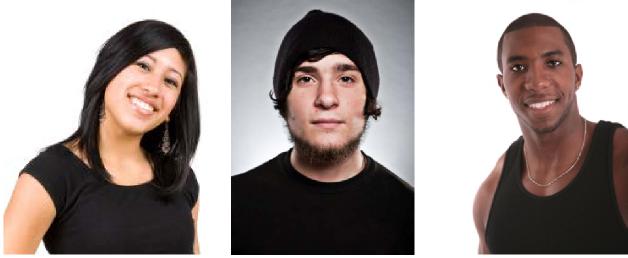
Which of these people might be a minor?
Module 2: Minors and Alcohol Sales
Key # 2: Know Your Customers
All of these people could potentially be minors!
Module 2: Minors and Alcohol Sales
Checking Identification
The safest way to avoid a sale to a minor is to check their identification. While the law does not state that you have to check an ID to sell or serve alcoholic beverages, the majority of retailers want to do the right thing and avoid alcohol sales to minors. Talk to your manager about your company's policy.
When to Ask for an ID
You should ask for an ID before you begin to serve or begin to ring up an alcohol sale.
- For off-premise sales, you can place your hands on the alcohol packaging and then ask for an ID, in case you need to remove the alcohol from reach.
- For on-premise sales, ask for an ID before pouring or serving the alcoholic beverage.
Module 2: Minors and Alcohol Sales
Checking Identification
Sec. 106.03. SALE TO MINORS
Not just any identification card is valid! A valid ID must:
- Appear to be valid (not expired, no obvious signs of alteration or forgery)
- Issued by a government agency
- Include a physical description and picture consistent with the customer's appearance.
- A birth date that is 21 years or more.
Module 2: Minors and Alcohol Sales
Checking Identification
Sec. 106.03. SALE TO MINORS
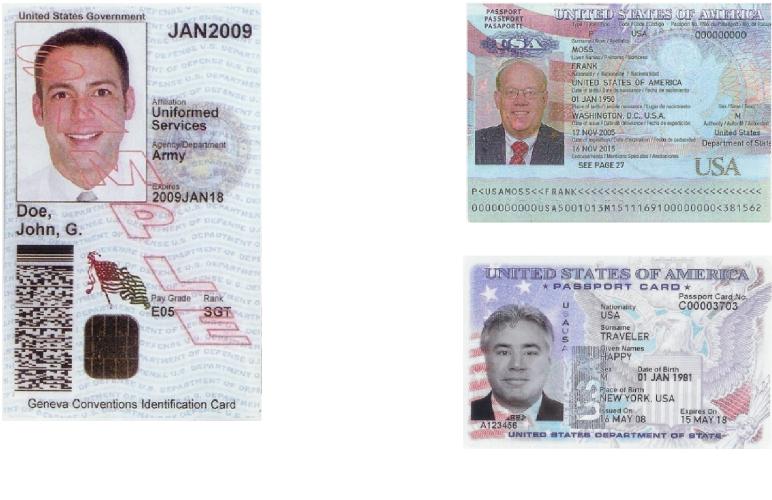
Examples of IDs that can be used are:
- Texas Driver's License
- Texas Identification Card
- Texas Temporary Driver's License
- Military ID
- U.S. Passports and passport cards
- Out-of-state drivers licenses or ID
Be sure to refer to your company's policy on what IDs they allow to be used. Your establishment may have policies in place that are stricter than Texas law.
Module 2: Minors and Alcohol Sales
Checking Identification
Sec. 106.03. SALE TO MINORS
Texas Driver's License and Identification Cards
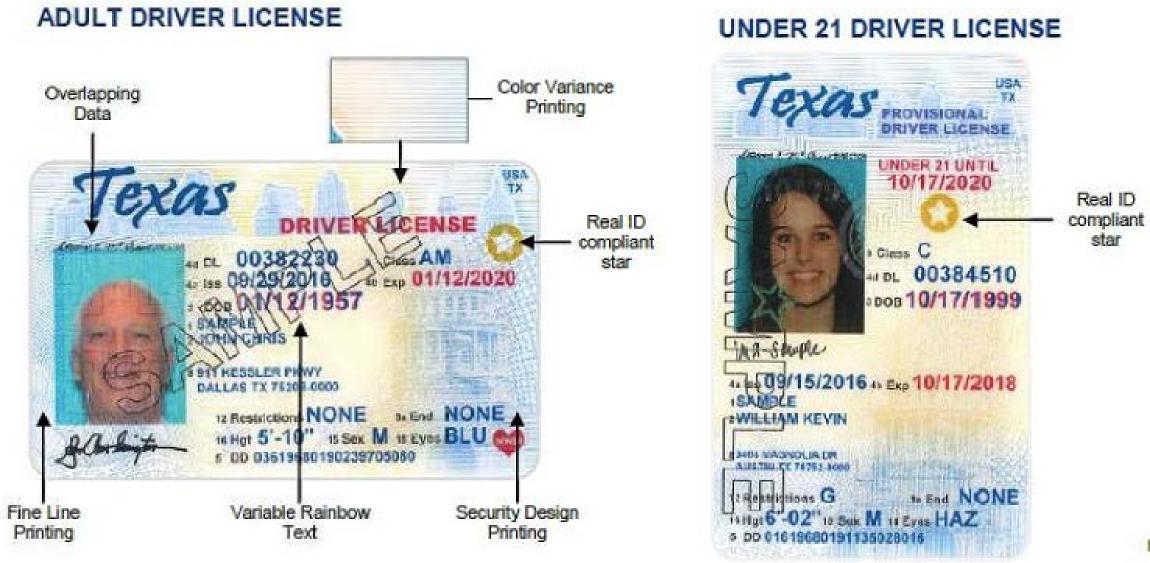
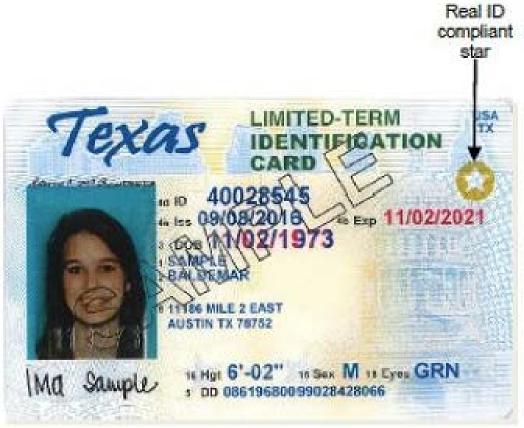
Texas Department of Public Safety issues driver's licenses and identification cards that have specific security features. Learn these features to be able to identify a valid ID.
A person can no longer be issued both a drivers license and identification card. Because of this law change, as a seller server make sure you know how to find the date of birth and know the security features on both a driver's license and identification card. You may start seeing more Identification cards since a person may no longer have both at the same time. Texas Transportation Code 521.183
Module 2: Minors and Alcohol Sales
Checking Identification
Sec. 106.03. SALE TO MINORS
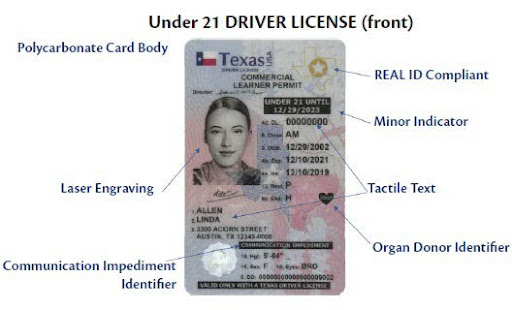
Minor Driver License
In February of 2020, the Texas Department of Public Safety began issuing a new version of Driver License and Identification cards. The cards are made of polycarbonate materials which is more tamper-resistant and harder to reproduce. This will make the cards feel different than previous versions.
On the Minor Driver License, the Under 21 Until date is located in a filled dark box with white text on the right hand side. There is also a ghost image that appears on the bottom left hand side of the card for individuals under 21 years of age, this image has a pattern overlay covering the photo.
Module 2: Minors and Alcohol Sales
Checking Identification
Sec. 106.03. SALE TO MINORS
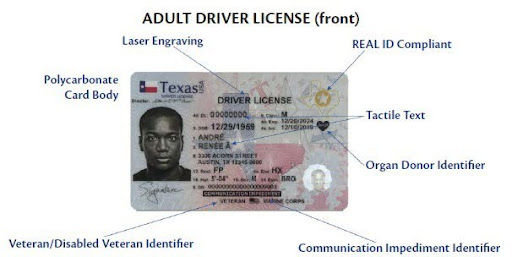
Front of Adult Driver’s License
Security Features:
-
Laser Engraving on the front provides maximum protection against data manipulation and forgery.
-
The REAL ID star indicates the card meets state and federal regulations.
-
A ghost image of the card holder appears in the bottom right corner for driver licenses and identification cards for individuals 21 years of age or older, this image has a pattern overlay covering the photo.
-
Tactile Text- The customer ID and name are laser engraved to raise the print making it difficult to tamper or modify.
-
Organ Donor Identifier- Card holders must specify if they are an organ donor and this identifier will appear on the front right of the card.
-
Communication Impediment Identifier- Cardholders can indicate they have a health condition that may impede their ability to communicate on the bottom center in black outline.
-
Veteran/Disabled Veteran Identifier- Veterans have the opportunity to have designation, along with the American Flag and branch of service, appear on the front of the driver license or ID card, allowing for immediate recognition of the cardholder’s military service.
Module 2: Minors and Alcohol Sales
Checking Identification
Sec. 106.03. SALE TO MINORS
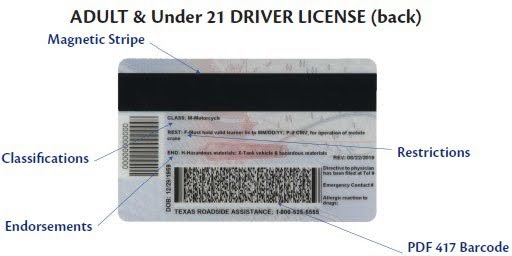
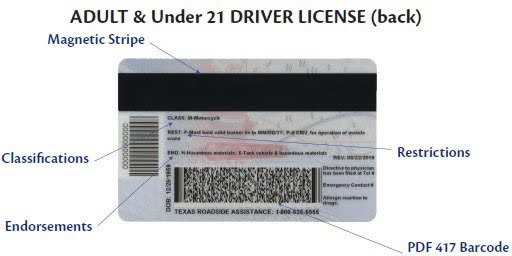
Back of Driver’s License Features:
On the back of the card will appear all restrictions, endorsements and classifications.
Magnetic Stripe: Three tracks of cardholder information is readable by a standard magnetic stripe reader.
Classifications: Cardholder specific classifications indicate the type(s) of vehicles the cardholder is authorized to operate.
Endorsements: Cardholder specific endorsements is applicable for commercial licenses only.
Restrictions: Cardholder specific restrictions limit when they can drive or requires that they meet specific conditions when they drive.
Module 2: Minors and Alcohol Sales
Checking Identification
Sec. 106.03. SALE TO MINORS
Texas REAL ID and Driver License
-
The Texas Department of Public Safety began issuing REAL ID compliant Driver License and Identification cards in October, 2016. On the next slide are some images of REAL ID and Driver Licenses. On the back of the card the Texas Roadside assistance number appears above the medical information and it used to appear below in previous versions.
-
The back of the license has a magnetic strip, endorsements and restrictions, bar code, roadside assistance number and medical information. On the front of the card when using UV lighting, the state seal appears with three stars in blue, silver and gold.
Module 2: Minors and Alcohol Sales
Checking Identification
Sec. 106.03. SALE TO MINORS
Texas REAL ID and Driver License
Module 2: Minors and Alcohol Sales
Checking Identification
Sec. 106.03. SALE TO MINORS
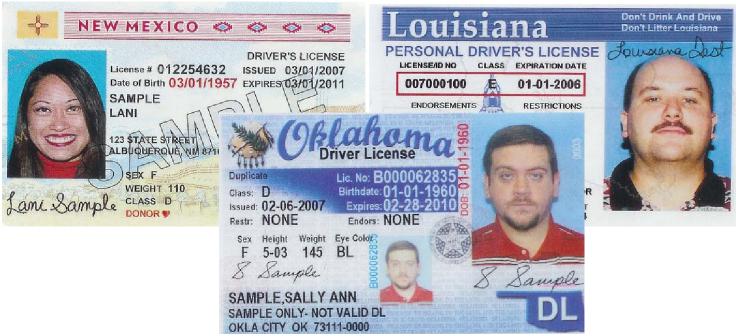
Out-Of-State ID Examples
Driver's licenses and ID cards from other states are allowed to be used as proof of age within the State of Texas if approved by your company's policy. The ID must be issued by a government agency, have a physical description and picture consistent with the customer's appearance, and show their age to be 21 years or older.
Module 2: Minors and Alcohol Sales
Checking Identification
Sec. 106.03. SALE TO MINORS
Federal ID Examples
Other IDs that are typically accepted are those issued by the federal government including military IDs, such as the example on the left and passports like the example on the right. Again, check your company's policy about what IDs you can accept as proof of age.
Module 2: Minors and Alcohol Sales
Checking Identification
Sec. 106.03. SALE TO MINORS
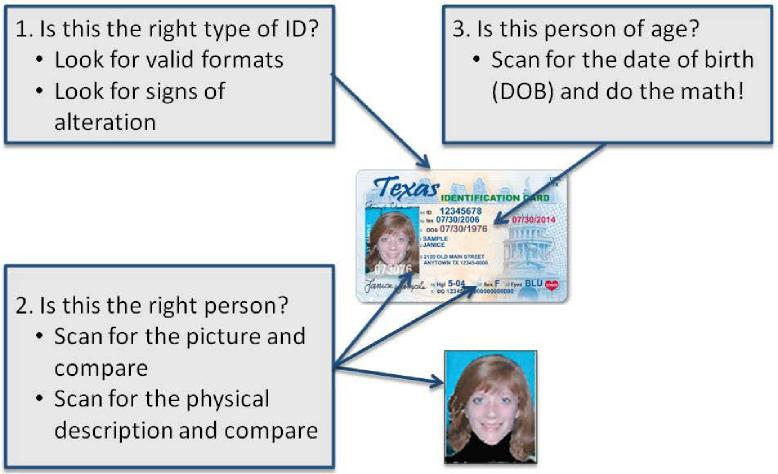
How to Check an ID
Learn to scan the ID for three critical things:
Make sure that it is a valid ID.
Make sure that the description and photo on the ID matches the person presenting it.
Check to see that the person is 21 years old or older.
Module 2: Minors and Alcohol Sales
JDWGh1o1iw8
Module 2: Minors and Alcohol Sales
Checking Identification
Sec. 109.61. USE OF CERTAIN ELECTRONICALLY READABLE INFORMATION. (Texas Alcoholic Beverage Code)
What it Means
The use of electronic scanning devices is legal, but it does not replace looking at the identification and matching the appearance of the person presenting it to the picture on the identification.
Use the information on the card, such as the photo and physical description, to validate that the identification belongs to the person presenting it.
Module 2: Minors and Alcohol Sales
Checking Identification
Fake Driver’s Licenses and IDs
Fake IDs are illegal to use, to possess, or to manufacture.
Whether purchased online or from a vendor, the document should indicate “not a government document.”
Module 2: Minors and Alcohol Sales
Checking Identification
Sec. 521.453. FICTITIOUS LICENSE OR CERTIFICATE. (Texas Transportation Code)
What it Means
- It is a Class C misdemeanor to possess with the intent to use, circulate, or pass a forged or counterfeit Texas Driver's License or Identification Card. Private citizens are not legally authorized to confiscate an ID.
Module 2: Minors and Alcohol Sales
Checking Identification
Sec. 521.456. DELIVERY OR MANUFACTURE OF COUNTERFEIT INSTRUMENT. (Texas Transportation Code)
What it Means
- It is a felony to manufacture or produce with the intent to sell, distribute or deliver any counterfeit or forged Texas Driver's License or Identification Card.
- It is a Class A misdemeanor to possess with the intent to sell, distribute, or deliver a forged or counterfeit Texas Driver's License or Identification Card.
Module 2: Minors and Alcohol Sales
Checking Identification
Sec. 521.451. GENERAL VIOLATION. (Texas Transportation Code)
-
It is a Class A misdemeanor to possess a fake or altered ID, to lend or let another person use your driver’s license or ID, or to use another person’s drivers license or ID.
-
It is a Class A misdemeanor to possess more than one valid driver’s license or ID.
-
It is a Class A misdemeanor to provide false information when applying for a driver’s license or ID.
Module 2: Minors and Alcohol Sales
Checking Identification
How to Watch for Fake IDs Watch for the following warning signs to identify fake IDs:
- Fuzzy printing on any numbers or letters or red eyes in the photo
- Bumpy surfaces around the picture, birth date, height, or weight
- The words "this is not a valid ID", "for amusement purposes only" or "Not a Government Document"
- An ID marked as a "duplicate" might indicate that the original license holder requested a second license for someone else
If you suspect the ID to be forged, you can ask about details like middle initials, address, and zip code. You can also ask for a second or even third form of ID. Questions that are answered with a hesitating response can mean a forgery.
NOTE: Even if an ID is a fake or does not belong to the person presenting it, you are not legally authorized to confiscate an ID.Module 2: Minors and Alcohol Sales
Key #3: Know How and When to Say "No"
If you are not 100 percent positive that the person is 21 years of age or older, or if you are not 100 percent positive that the ID presented is valid, then you should not make the sale. This section provides guidance on how to say "No" to an illegal sale of alcohol.
Module 2: Minors and Alcohol Sales
Key #3: Know How and When to Say "No"
What are the Keys to Saying "No"?
You now know the law and how to determine if a person is a minor. Now you will learn about how to prevent an illegal sale of alcoholic beverages to a minor with the Keys to Intervention. In order to prevent an illegal sale of alcohol, you need to:
- Be Quick - You must be timely in order to be effective.
- Be Clear and Firm - Be polite to your customer, but be clear and firm in your refusal to sell alcohol.
- Be consistent - Say "No" in the same way every time.
Module 2: Minors and Alcohol Sales
Key #3: Know How and When to Say "No"
The keys to saying "No" to selling alcohol to a minor are:
Be Quick
The best time to say "No" is before any alcoholic beverage is sold or served. Quickly place the alcohol out of reach and, if possible, out of sight.
Be Clear and Firm
Refuse the sale politely but firmly. Politely state the reason that you can't make the sale. State the laws about selling to a minor, Minors attempting to buy alcohol, and about a minor possessing alcoholic beverages. Let the minor know that you both could get in legal trouble if you made the sale.
Module 2: Minors and Alcohol Sales
Key #3: Know How and When to Say "No"
The keys to saying "No" to selling alcohol to a minor are:
Be Consistent
Don't go back on your refusal for any reason. If the customer begins to argue, simply restate the reason that you can't legally make the sale. It is the employee's obligation to notify law enforcement authorities when intervention attempts fail. Ask your manager about policies and procedures for reporting incidents.
Module 2: Minors and Alcohol Sales
Key #3: Know How and When to Say "No"
What might happen if you refuse to sell or serve alcoholic beverages to a person that cannot prove that they are 21 or older?
Module 2: Minors and Alcohol Sales
Key #3: Know How and When to Say "No"
What might happen if you refuse to sell or serve alcoholic beverages to a person that cannot prove that they are 21 or older?
The customer might get mad. The customer might argue or try to talk you into making the sale. The customer might understand and agree that it is too risky for you to make the sale.
Module 2: Minors and Alcohol Sales
Key #3: Know How and When to Say "No"
What else might you do or say to make the person know that you are not going to change your mind and make the sale?
Module 2: Minors and Alcohol Sales
Key #3: Know How and When to Say "No"
What else might you do or say to make the person know that you are not going to change your mind and make the sale?
We could both get into legal trouble. If you'd like, I will get my manager for you.
Module 2: Minors and Alcohol Sales
Summary
You should now be able to:
- Given a scenario, state if a sale of alcohol is legal or illegal with regards to a minor.
- Use observations to detect that a minor is attempting to purchase alcohol.
- Correctly identify if an ID is valid and proper for purposes of establishing age.
- Recall that possession, use, manufacture, or misuse of an ID is an illegal act.
- Given a scenario, select appropriate intervention techniques in regards to a minor attempting to purchase alcohol.
Module 2: Minors and Alcohol Sales
Summary
This module included:
Key #1: Know the Law- For Minors
- For Seller-Servers
- Checking Identification
Module 2: Minors and Alcohol Sales
Summary
- It is law that in the event of possible alcohol poisoning, a person under 21 calling for help will not be cited for possessing or consuming alcohol. The immunity for minors is limited to the first person who calls for help, only if he or she stays on the scene and cooperates with law enforcement and medical personnel. The new law does not protect a person from being cited for any other violation.
- The offenses of consumption or possession of alcohol by a minor do not apply to a minor who reports that the minor or another person was sexually assaulted or by a minor who was the victim of a sexual assault as reported by another person. The report must be made to certain authorities. To claim the defense, the minor had to have been consuming or in possession of alcohol at the time the reported sexual assault took place.
Module 2: Minors and Alcohol Sales
MODULE 2 REVIEW
Now let's test what you learned with this short quiz.
Module 3: Intoxicated People and Alcohol Sales
In this module, we will focus on preventing illegal alcohol sales to people that are intoxicated.
Module Objectives
When you complete this module, you will be able to:
- Describe how seller-servers are responsible for the acts of their customers (Dram Shop Act).
- Given a scenario, state if a sale of alcohol is legal or illegal with regards to an intoxicated person.
- Define blood alcohol concentration (BAC) and list factors that affect BAC in individuals.Use observations to detect if a person is intoxicated
- Given a scenario, select appropriate intervention techniques for preventing sales to intoxicated persons.
Module 3: Intoxicated People and Alcohol Sales
Topics in this module
Key #1: Know the Law
Intoxication Laws
Dram Shop Act
Driving and Alcohol
Key #2 Use Observations to Know Your Customers
Signs of Intoxication
Other methods of determining intoxication
Key #3: Know When and How to Say “No”
Module 3: Intoxicated People and Alcohol Sales
Codes and Rules
Sec. 49.02. PUBLIC INTOXICATION. (Texas Penal Code)
(a) A person commits an offense if the person appears in a public place while intoxicated to the degree that the person may endanger the person or another.
(a-1) For the purposes of this section, a premises licensed or permitted under the Alcoholic Beverage Code is a public place.
(b) It is a defense to prosecution under this section that the alcohol or other substance was administered for therapeutic purposes and as a part of the person's professional medical treatment by a licensed physician.
(c) Except as provided by Subsection (e), an offense under this section is a Class C misdemeanor.
Module 3: Intoxicated People and Alcohol Sales
Codes and Rules
Sec. 49.02. PUBLIC INTOXICATION. (Texas Penal Code)
(d) An offense under this section is not a lesser included offense under Section 49.04.
(e) An offense under this section committed by a person younger than 21 years of age is punishable in the same manner as if the minor committed an offense to which Section 106.071, Alcoholic Beverage Code, applies.
Module 3: Intoxicated People and Alcohol Sales
Codes and Rules
Sec. 49.02. PUBLIC INTOXICATION. (Texas Penal Code)
What it Means
Under Texas law, it is illegal for a person to be intoxicated in a public place to the degree that they might be a danger to themselves or others. A business that is licensed or permitted to sell or serve alcoholic beverages is considered a public place. [Texas Penal Code 49.02]
Module 3: Intoxicated People and Alcohol Sales
Codes and Rules
Sec. 101.63. SALE TO CERTAIN PERSONS. (Texas Alcoholic Beverage Code)
(a) A person commits an offense if the person with criminal negligence sells an alcoholic beverage to a habitual drunkard or an intoxicated or insane person.
(a-1) A person commits an offense if the person with criminal negligence delivers for commercial purposes an
alcoholic beverage to an intoxicated person.
(b)Except as provided in Subsection (c) of this section, a violation of this section is a misdemeanor punishable by a fine of not less than $100 nor more than $500, by confinement in jail for not more than one year, or by both.
(c) If a person has been previously convicted of a violation of this section or of Section 106.03 of this code, a violation is a misdemeanor punishable by a fine of not less than $500 or more than $1,000, by confinement in jail for not more than one year, or by both.
Module 3: Intoxicated People and Alcohol Sales
Codes and Rules
Sec. 101.63. SALE TO CERTAIN PERSONS. (Texas Alcoholic Beverage Code)
What it Means
It is illegal to sell an alcoholic beverage to a person that you know is intoxicated. [Texas Alcoholic Beverage Code Sec. 101.63 (a)] The penalties are:
First offense
A fine of not less than $100 nor more than $500;
Confinement in jail for not more than one year;
Both a fine and confinement.
Second offense
A fine of not less than $500 nor more than $1000;
Confinement in jail for not more than one year;
Both a fine and confinement
Module 3: Intoxicated People and Alcohol Sales
Codes and Rules
Sec. 104.01. LEWD, IMMORAL, INDECENT CONDUCT. (Texas Alcoholic Beverage Code)
No person authorized to sell beer at retail, nor his agent, servant, or employee, may engage in or permit conduct on the premises of the retailer which is lewd, immoral, or offensive to public decency, including, but not limited to, any of the following acts:
(1) the use of loud and obscene, vulgar, or indecent language, or permitting its use;
(2) the exposure of person or permitting a person to expose his person;
(3) rudely displaying or permitting a person to rudely display a pistol or other deadly weapon in a manner calculated to disturb persons in the retail establishment;
(4) solicitation of any person to buy drinks for consumption by the retailer or any of his employees;
Module 3: Intoxicated People and Alcohol Sales
Codes and Rules
Sec. 104.01. LEWD, IMMORAL, INDECENT CONDUCT. (Texas Alcoholic Beverage Code)
No person authorized to sell beer at retail, nor his agent, servant, or employee, may engage in or permit conduct on the premises of the retailer which is lewd, immoral, or offensive to public decency, including, but not limited to, any of the following acts:
(5) being intoxicated on the licensed premises;
(6) permitting lewd or vulgar entertainment or acts;
(7) permitting solicitations of persons for immoral or sexual purposes;
(8) failing or refusing to comply with state or municipal health or sanitary laws or ordinances; or
(9) possession of a narcotic or any equipment used or designed for the administering of a narcotic or permitting a person on the licensed premises to do so.
Module 3: Intoxicated People and Alcohol Sales
Codes and Rules
Sec. 104.01. LEWD, IMMORAL, INDECENT CONDUCT. (Texas Alcoholic Beverage Code)
What it Means
It is illegal for an employee to ask a customer to buy them a drink, or to be intoxicated on the premise where they work as a seller-server. [Texas Alcoholic Beverage Code Sec. 104.01]
Module 3: Intoxicated People and Alcohol Sales
Codes and Rules
Given the following scenarios, is this sale legal or illegal?
A person walks into your bar or restaurant and is obviously intoxicated. Is it legal to serve them alcoholic beverages?
Module 3: Intoxicated People and Alcohol Sales
Codes and Rules
Given the following scenarios, is this sale legal or illegal?
A person walks into your bar or restaurant and is obviously intoxicated. Is it legal to serve them alcoholic beverages? ILLEGAL
Module 3: Intoxicated People and Alcohol Sales
Codes and Rules Given the following scenarios, is this sale legal or illegal?
If a person drinks alcohol in your bar or restaurant and you know that they have become intoxicated, is it legal to continue to serve them alcoholic beverages?
Module 3: Intoxicated People and Alcohol Sales
Codes and Rules Given the following scenarios, is this sale legal or illegal?
If a person drinks alcohol in your bar or restaurant and you know that they have become intoxicated, is it legal to continue to serve them alcoholic beverages? ILLEGAL
Module 3: Intoxicated People and Alcohol Sales
Codes and Rules Given the following scenarios, is this sale legal or illegal?
If a person walks into your retail store and you can tell that they are intoxicated, is it legal to sell them alcoholic beverages?
Module 3: Intoxicated People and Alcohol Sales
Codes and Rules Given the following scenarios, is this sale legal or illegal?
If a person walks into your retail store and you can tell that they are intoxicated, is it legal to sell them alcoholic beverages? ILLEGAL
Module 3: Intoxicated People and Alcohol Sales
Codes and Rules - Dram Shop Laws
Sec. 2.02. CAUSES OF ACTION. (Texas Alcoholic Beverage Code)
What it Means
"Dram Shop" is a legal term referring to a bar, or retailer where alcoholic beverages are sold. The law known as the Dram Shop Act deals with the responsibility of businesses that sell alcohol to people who are obviously intoxicated to the extent that he or she presents a clear danger to him or herself or others, who subsequently cause property damage, injury, or death to themselves or others.
This means that if alcohol is sold to an intoxicated person, and that person is involved in an accident, then who ever sold, served, or provided the alcoholic beverages may be found liable for personal injury or property damage caused in the accident.
This law says that YOU, as a seller-server of alcohol, have the responsibility of making sure that alcohol is not sold to someone that is intoxicated.
[Texas Alcoholic Beverage Code Sec. 2.02]
Module 3: Intoxicated People and Alcohol Sales
Dram Shop Act
Definition:
Dram Shop Act refers to the law governing the civil liability of a provider who sells/serves/provides alcohol beverages; including, but not limited to licensees or permitees. Civil liability allows a person(s) who is injured or suffers property damage to sue the provider in civil court.
Background:
Texas Legislature enacted the Dram Shop Act on June 1, 1987 in Chapter 2 of the Texas Alcoholic Beverage Code. Section 2.03 of the Code says Chapter 2 is the exclusive means of pursuing the provider for damages resulting from intoxication.
Module 3: Intoxicated People and Alcohol Sales
Dram Shop Act
What it Means:
The Act establishes that providers including licensees/permitees are liable for actions of their employees, customers, members or guests who are or become intoxicated and cause injury or property damage to themselves or a third party. Establishments can be held liable in civil court when an employee sells/serves/provides alcohol to an obviously intoxicated person (including minors) who presents a clear danger to him/herself or others and who subsequently causes injury or damage.
Penalties:
The licensee/permitee is subject to revocation of their license/permit for violating the Dram Shop Act. Liability for damages caused would be determined in a civil court.
Module 3: Intoxicated People and Alcohol Sales
Key #2: Know Your Customers
It is up to you to decide if a customer is intoxicated and should not be sold or served alcohol.
What Are The Keys To Customer Observation for Intoxication?
To decide if a sale of alcohol is legal, watch your customers to:
- See How They Look - Look at your customer and notice their general appearance.
- See What They Do - Watch your customer's movements and behaviors.
- See How They React - Watch how your customer interacts with you and others.
- See How Much Alcohol Has Been Purchased or Consumed - Watch the tab and see how many drinks have been consumed.
Module 3: Intoxicated People and Alcohol Sales
Likely Signs of Intoxication
- Loud speech
- Bravado, boasting
- Overly animated or entertaining
- Boisterous
- Careless with money
- Annoying other customers and/or the seller
- Argumentative
- Aggressive or belligerent
- Obnoxious or mean
- Inappropriate comments about others
- Crude behavior
Module 3: Intoxicated People and Alcohol Sales
Likely Signs of Intoxication
- Inappropriate sexual advances
- Foul language
- Irrational statements
- Depressed or sullen
- Crying or moody
- Speaking loudly, then quietly
- Drowsy
- Bloodshot, glassy eyes
- Slurred speech
- Difficulty remembering
- Slow response to questions
- Rambling conversation
Module 3: Intoxicated People and Alcohol Sales
Likely Signs of Intoxication
- Loss of train of thought
- Trouble making change
- Difficulty handling money
- Difficulty picking up change
- Lack of focus and eye contact
- Clumsy, uncoordinated
- Difficulty standing
- Unusual gait (walk)
- Stumbling
- Bumping into things
- Dropping things
- Swaying, staggering
Module 3: Intoxicated People and Alcohol Sales
Likely Signs of Intoxication
- Falling down
- Mussed hair
- Disheveled clothing
- Falling asleep
- Smells like alcohol
Module 3: Intoxicated People and Alcohol Sales
Likely Signs of Intoxication ON PREMISE
- Loud speech
- Bravado, boasting
- Overly animated or entertaining
- Boisterous
- Careless with money
- Annoying other customers and/or the seller
- Argumentative
- Aggressive or belligerent
- Obnoxious or mean
- Inappropriate comments about others
- Crude behavior
- Inappropriate sexual advances
Module 3: Intoxicated People and Alcohol Sales
Likely Signs of Intoxication ON PREMISE
- Foul language
- Irrational statements
- Depressed or sullen
- Crying or moody
- Speaking loudly, then quietly
- Drowsy
- Bloodshot, glassy eyes
- Slurred speech
- Difficulty remembering
- Slow response to questions
- Rambling conversation
- Loss of train of thought
Module 3: Intoxicated People and Alcohol Sales
Likely Signs of Intoxication ON PREMISE
- Trouble making change
- Difficulty handling money
- Difficulty picking up change
- Lack of focus and eye contact
- Clumsy, uncoordinated
- Difficulty standing
- Unusual gait (walk)
- Stumbling
- Bumping into things
- Dropping things
- Swaying, staggering
- Falling down
Module 3: Intoxicated People and Alcohol Sales
Likely Signs of Intoxication ON PREMISE
- Mussed hair
- Disheveled clothing
- Falling asleep
- Smells like alcohol
Module 3: Intoxicated People and Alcohol Sales
Observing Your Customers
Use your observations of customer's appearance, behaviors, and reactions to determine if they are intoxicated or becoming intoxicated.
For off-premise sales, you may only have a few moments to determine if a customer is intoxicated.
To better protect yourself, on-premise servers should be able to keep a count of the drinks served to the customer and periodically reassess the customer for signs of intoxication. Remember that alcohol takes time to reach the brain and cause intoxication. If you feel another alcoholic beverage would make the customer intoxicated or possibly intoxicated, you should not serve.
Observe your customer's appearance.
- They may become flushed in the face as the alcohol dilates blood vessels.
- They may not be aware of their appearance and have mussed hair or disheveled clothing.
Module 3: Intoxicated People and Alcohol Sales
Observing Your Customers
Observe your customer's behavior.
- Talk to the customer when they first enter your establishment and use this to establish a baseline.
- They may be clumsy and less able to perform ordinary tasks, such as lighting a cigarette or picking up change. They may feel invincible and take more risks than when sober.
Observe your customer's interactions with others.
- An intoxicated person may not be able to speak coherently.
- An intoxicated person may be argumentative.
- An intoxicated person can lose their inhibitions while drinking alcohol; they can say and do things they would not ordinarily do.
Module 3: Intoxicated People and Alcohol Sales
Observing Your Customers - Additional Observation Methods
Not all customers will display the typical signs of intoxication. You hear people say they have a "tolerance" for alcohol, which may not be accurate. They have learned to control the behaviors that are signs of intoxication.
Conversation, close observation, and drink counting may be the only tools you have to determine that someone is intoxicated even though they are not showing the typical signs of intoxication.
-
You may be able to keep track of the number of drinks served to a customer and estimate their blood alcohol concentration, as described in the next section.
-
Periodically reassess if a customer is becoming intoxicated. You can ask open-ended questions that require them to think about the answers. Their reaction time will be much longer if they are intoxicated.
Module 3: Intoxicated People and Alcohol Sales
Observing Your Customers - Additional Observation Methods
You should rely on your observations and not just the number of drinks served because:
-
You may not know all of the factors that affect their intoxication level.
-
They may have had alcohol before they arrived.
On-premise servers should only use drink counting in addition to watching for other signs of intoxication.
Module 3: Intoxicated People and Alcohol Sales
Blood Alcohol Concentration (BAC)
Blood alcohol concentration (BAC) is a measurement of the amount of alcohol in the bloodstream expressed as a percentage. For example, if someone has a BAC of 0.10 percent this means that the person has one part chemical alcohol with 1000 parts blood fluids.
As a person drinks alcohol their BAC will rise, whether or not they show signs of intoxication. A person might also become intoxicated at lower BAC levels. However, you can use these guidelines for drink counting and watching for possible intoxication.
Module 3: Intoxicated People and Alcohol Sales
Blood Alcohol Concentration (BAC)
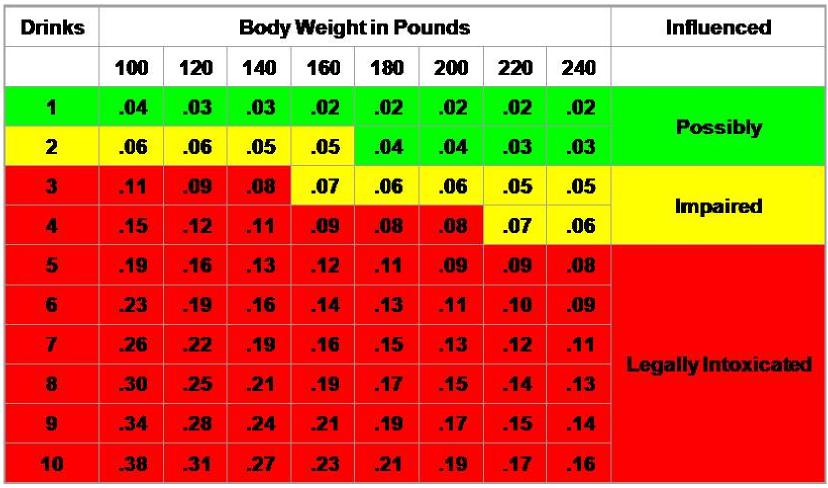
You can use the following charts to estimate a customer's BAC and know when they are possibly influenced, impaired, or intoxicated. These charts are only examples and were developed by the National Highway Traffic Safety Administration.
Subtract .015 for each hour after drinking. One drink is based on 1.5 oz of 80 proof liquor (40%), 12 oz. beer (4.5%), or 5 oz. wine (12%). The figures are averages and may vary based on the amount of food in the stomach.
It is important to remember that in Texas a .08% blood-alcohol percentage or higher is considered above the legal limit to operate a motor vehicle.
Module 3: Intoxicated People and Alcohol Sales
Blood Alcohol Concentration (BAC)
Module 3: Intoxicated People and Alcohol Sales
Blood Alcohol Concentration (BAC)
What is a Standard Drink?
Remember not all drinks are equal when counting drinks. Multi-liquor drinks or over sized drinks have more alcohol than a single shot drink or a regular 12-ounce beer.
12 oz. - regular beer 5% alcohol
8-9 oz.. - malt liquor 7% alcohol
5 oz. - table wine 13% alcohol
3-4 oz. - fortified wine 17% alcohol
2-3 oz. - cordial liqueur 24% alcohol
1.5 oz. - brandy spirits 40% alcohol
1.5 oz. - 80-proof alcohol 40% alcohol
Module 3: Intoxicated People and Alcohol Sales
Blood Alcohol Concentration (BAC)
What is a Standard Drink?
In the United States, a "standard" drink is any drink that contains about 0.6 fluid ounces or 14 grams of "pure" alcohol. Below is the approximate number of standard drinks in different sized containers of alcohol:
| Regular Beer | Malt Liquor | Table Wine | 80 Proof Spirits ("hard liquor") |
| 5% ABV | 7% ABV | 12% ABV | 40% ABV |
| 12oz = 1 16 oz = 1.3 |
12 oz = 1.5 16 oz = 2 |
750 ml Bottle = 5 | 1.5 oz = 1 Mixed Drink = 1 or more |
Module 3: Intoxicated People and Alcohol Sales
Blood Alcohol Concentration (BAC)
It is a myth that white wine is a good choice for a person who wants a light drink with less alcohol. In fact, a 5-ounce glass of white or red wine, a 12-ounce bottle or can of beer, or a shot of 1 1/2-ounce of 80-proof distilled spirits (either straight or in a mixed drink) contain an equivalent amount of alcohol.
Estimating a customer's Blood Alcohol Concentration based on drink counting
1.) A man who weighs approximately 220 pounds has one, 24-ounce glass of beer in one hour.
Number of standard drinks: ____ Estimated BAC: ____
Possibly Impaired ____ Impaired _____ Intoxicated_____
Module 3: Intoxicated People and Alcohol Sales
Blood Alcohol Concentration (BAC)
1.) A man who weighs approximately 220 pounds has one, 24-ounce glass of beer in one hour.
Number of standard drinks: _2 Estimated BAC: __.03__
Possibly Impaired _x___ Impaired _____ Intoxicated_____
Module 3: Intoxicated People and Alcohol Sales
Blood Alcohol Concentration (BAC)
2.) A woman who weighs approximately 120 pounds has three, 5-ounce glasses of wine in two hours.
Number of standard drinks: _____ Estimated BAC: _____
Possibly Impaired ____ Impaired _____ Intoxicated______
Module 3: Intoxicated People and Alcohol Sales
Blood Alcohol Concentration (BAC)
2.) A woman who weighs approximately 120 pounds has three, 5-ounce glasses of wine in two hours.
Number of standard drinks: _3___ Estimated BAC: _.095 (0.11 - .015)___
Possibly Impaired ____ Impaired _____ Intoxicated__x___
Module 3: Intoxicated People and Alcohol Sales
Blood Alcohol Concentration (BAC)
3.) A man who weighs approximately 140 pounds has two, 12-ounce beers and one 1 1/2 oz. shot of liquor in two hours.
Number of standard drinks: ____ Estimated BAC: ____
Possibly Impaired ____ Impaired _____ Intoxicated_____
Module 3: Intoxicated People and Alcohol Sales
Blood Alcohol Concentration (BAC)
3.) A man who weighs approximately 140 pounds has two, 12-ounce beers and one 1 1/2 oz. shot of liquor in two hours.
Number of standard drinks: _3___ Estimated BAC: .065 (0.08 -0.015)
Possibly Impaired ____ Impaired _x___ Intoxicated_____
Module 3: Intoxicated People and Alcohol Sales
Blood Alcohol Concentration (BAC)
4.) A woman who weighs approximately 180 pounds has two, “double” mixed drinks in three hours.
Number of standard drinks: ____ Estimated BAC: ____
Possibly Impaired ____ Impaired _____ Intoxicated_____
Module 3: Intoxicated People and Alcohol Sales
Blood Alcohol Concentration (BAC)
4.) A woman who weighs approximately 180 pounds has two, "double" mixed drinks in three hours.
Number of standard drinks: _4___ Estimated BAC: _.07 (0.10 -.03)___
Possibly Impaired ____ Impaired ___x__ Intoxicated_____
Module 3: Intoxicated People and Alcohol Sales
Blood Alcohol Concentration (BAC)
Other Factors Related to Intoxication
The following can affect BAC and intoxication; therefore, always consider whether the person appears to be intoxicated.
Gender - On average it takes a woman's body longer to metabolize one drink than the average male. It may take a man 1.5 hours, and a woman 2.5 hours to metabolize one drink.
Body weight and type - In general, the more a person weighs the more alcohol they can consume before becoming intoxicated. Remember this is just an estimate and other factors may determine the actual level of intoxication.
Muscle/fat ratio - Body fat doesn't absorb alcohol. Instead it forces the alcohol to remain in the bloodstream until the liver can break it down. Because of this, a more muscular person would have a lower BAC compared to a person with more fat.
Module 3: Intoxicated People and Alcohol Sales
Blood Alcohol Concentration (BAC)
Other Factors Related to Intoxication
The following can affect BAC and intoxication; therefore, always consider whether the person appears to be intoxicated.
Type and timing of food - The amount of food and type of food in the stomach determines how fast the alcohol is absorbed into the bloodstream. Foods with a high fat content, such as meats or cheeses, are a wise choice since these foods are metabolized at a slower rate.
Fatigue - A person who is fatigued, emotionally upset, or in poor health may become intoxicated more quickly and will retain alcohol longer.
Module 3: Intoxicated People and Alcohol Sales
Blood Alcohol Concentration (BAC)
Do the signs of intoxication change if a person takes over-the-counter drugs?
Module 3: Intoxicated People and Alcohol Sales
Blood Alcohol Concentration (BAC)
Do the signs of intoxication change if a person takes over-the-counter drugs?
No, the signs of intoxication will remain the same but they may appear more quickly than if the person was not taking medication.
Module 3: Intoxicated People and Alcohol Sales
Blood Alcohol Concentration (BAC)
Do the signs of intoxication change if a person is tired or depressed?
Module 3: Intoxicated People and Alcohol Sales
Blood Alcohol Concentration (BAC)
Do the signs of intoxication change if a person is tired or depressed?
No, the signs of intoxication will remain the same but they may appear more quickly than if the person was well rested or not depressed.
Module 3: Intoxicated People and Alcohol Sales
Blood Alcohol Concentration (BAC)
Other Causes of Intoxication
Your observations are most important because intoxication can be caused by factors other than the drinks that the customer has had in their establishment.
Prescription, Over the Counter, or Illegal Drugs
If a person is taking prescription, over the counter, or illegal drugs it will not change their BAC. However, the person's reaction to the alcohol may increase, and they may become intoxicated more quickly. Some prescription medicines combined with alcohol consumption may be deadly.
Weight loss drugs and caffeine are stimulants. They may cause a person to feel alert, but do not change the effect of alcohol on reaction time and judgment.
Analgesics (pain killers), cold remedies, or cough medicines can cause drowsiness, which can slow reaction time, slow judgment, and increase signs of intoxication.
Module 3: Intoxicated People and Alcohol Sales
Blood Alcohol Concentration (BAC)
Other Causes of Intoxication - Drink Tampering
Be aware that drink tampering does occur. These drugs are sometimes referred to as date rape drugs. The drugs used in most cases are Rohypnol and Gammahydroxybutyrate (GHB). They are slipped into drinks when the target individual is distracted or leaves a drink unattended. The drugs may cause deep sedation, respiratory distress, blackouts, forgetfulness, and make sexual assault more likely.
There is no unusual taste or look to a drink contaminated by either of these drugs. Drug manufacturers have responded to this by making Rohypnol turn blue when placed in drinks; GHB turns drinks cloudy. However, these drugs can be obtained off the regular market with the old formulations.
Be aware of any suspicious activities where someone might have placed a drug in an unattended drink or in a drink when someone is distracted. If you suspect drink tampering, remove the tampered drink with the pretext of bringing a fresh drink, alert management, and offer assistance.
Module 3: Intoxicated People and Alcohol Sales
Blood Alcohol Concentration (BAC)
Other Causes of Intoxication - Alcohol Poisoning
Alcohol depresses nerves that control involuntary actions such as breathing and the gag reflex (which prevents choking). A fatal dose of alcohol will eventually stop these functions.
It is common for someone who consumed excessive alcohol to vomit since alcohol is an irritant to the stomach. There is also the danger of choking on vomit, which could cause death by asphyxiation in a person who is not conscious because of intoxication.
It is a myth that it is good to throw up at the end of a night of drinking "because it gets the alcohol out of the system." In fact, throwing up is a sign the body is getting toxic. It is also a myth that coffee will help sober someone up; only time can sober a person up.
You should also know that a person's BAC can continue to rise even while he or she is passed out. Even after a person stops drinking, alcohol in the stomach and intestine continues to enter the bloodstream and circulate throughout the body.
Module 3: Intoxicated People and Alcohol Sales
Blood Alcohol Concentration (BAC)
Other Causes of Intoxication - Alcohol Poisoning
Alcohol poisoning is a dangerous consequence of excessive drinking.
Signs and symptoms of alcohol poisoning:
-
Mental confusion, stupor, coma, or person cannot be roused
-
Vomiting
-
Slow breathing (fewer than eight breaths per minute)
-
Irregular breathing (10 seconds or more between breaths)
-
Hypothermia (low body temperature), bluish skin color, paleness
If you suspect someone has alcohol poisoning:
-
Do not wait for all symptoms to be present.
-
Do not leave a person who passes out to "sleep it off". Be aware that a person who has passed out may die.
-
If there is any suspicion of an alcohol overdose, call 911 for help. Do not try to guess the level of drunkenness.
Module 3: Intoxicated People and Alcohol Sales
Blood Alcohol Concentration (BAC)
Other Causes of Intoxication - Alcohol Poisoning
If alcohol poisoning goes untreated?
-
The victim may choke on his or her own vomit.
-
Breathing slows, becomes irregular, or stops.
-
Heart beats irregularly or stops.
-
Hypothermia (low body temperature) may occur.
-
Hypoglycemia (too little blood sugar) leads to seizures.
-
Untreated severe dehydration from vomiting can cause seizures, permanent brain damage, or death.
NOTE: Binge drinking (the consumption of five or more drinks in a row by men, or four or more drinks in a row by women, within a two hour period) is especially dangerous because the victim can ingest a fatal dose of alcohol before becoming unconscious.
Module 3: Intoxicated People and Alcohol Sales
REVIEW
- Some over-the-counter drugs combined with alcohol can increase the rate at which a person becomes intoxicated.
- True
- False
- A mixed drink may include two or three "standard drinks."
- True
- False
- A 5-ounce glass of wine has the same alcohol as a 12-ounce beer.
- True
- False
- Blood alcohol concentration (BAC) is a measurement of the amount of alcohol in the bloodstream expressed as a percentage.
- True
- False
- A person can be intoxicated even if their BAC is below .08 percent; therefore, watch for signs to confirm intoxication.
- True
- False
- A person who is very tired or physically exhausted may become intoxicated more quickly.
- True
- False
Module 3: Intoxicated People and Alcohol Sales
REVIEW
- Some over-the-counter drugs combined with alcohol can increase the rate at which a person becomes intoxicated.
- True
- False
- A mixed drink may include two or three "standard drinks."
- True
- False
- A 5-ounce glass of wine has the same alcohol as a 12-ounce beer.
- True
- False
- Blood alcohol concentration (BAC) is a measurement of the amount of alcohol in the bloodstream expressed as a percentage.
- True
- False
- A person can be intoxicated even if their BAC is below .08 percent; therefore, watch for signs to confirm intoxication.
- True
- False
- A person who is very tired or physically exhausted may become intoxicated more quickly.
- True
- False
Module 3: Intoxicated People and Alcohol Sales
REVIEW
1. Which of the following observations could be a sign that a customer is becoming intoxicated?
- You observe a customer laughing and talking louder and louder as the night goes on.
- You observe the customer weaving and bumping into tables when walking to the restroom.
- You observe a customer rest his head on the table and closes his eyes.
- All of the above.
Module 3: Intoxicated People and Alcohol Sales
REVIEW
1. Which of the following observations could be a sign that a customer is becoming intoxicated?
- You observe a customer laughing and talking louder and louder as the night goes on.
- You observe the customer weaving and bumping into tables when walking to the restroom.
- You observe a customer rest his head on the table and closes his eyes.
- All of the above.
Module 3: Intoxicated People and Alcohol Sales
REVIEW
2. Which of the following observations could be a sign that a customer is intoxicated?
- You see a customer falling as she gets out of her car and is visibly stumbling on the curb before entering your venue.
- You notice the smell of alcohol when a customer comes to the counter, his face is flushed, and you observe the customer fumbling and dropping his wallet while retrieving his money.
- You observe a customer leaning on his friend as they weave through the aisles of the store.
- All of the above
Module 3: Intoxicated People and Alcohol Sales
REVIEW
2. Which of the following observations could be a sign that a customer is intoxicated?
- You see a customer falling as she gets out of her car and is visibly stumbling on the curb before entering your venue.
- You notice the smell of alcohol when a customer comes to the counter, his face is flushed, and you observe the customer fumbling and dropping his wallet while retrieving his money.
- You observe a customer leaning on his friend as they weave through the aisles of the store.
- All of the above
Module 3: Intoxicated People and Alcohol Sales
REVIEW
3. Fatigue, medication, drugs, or illness:
- Decrease the effect alcohol has on a person
- Increase the effect alcohol has on a person
- Are not factors on the effect of alcohol
- None of the above
Module 3: Intoxicated People and Alcohol Sales
REVIEW
3. Fatigue, medication, drugs, or illness:
- Decrease the effect alcohol has on a person
- Increase the effect alcohol has on a person
- Are not factors on the effect of alcohol
- None of the above
Module 3: Intoxicated People and Alcohol Sales
REVIEW
4. Who is responsible for deciding if a person is intoxicated and if the sale of alcohol to them would be illegal?
- The person who actually serves, sells, or delivers the alcoholic beverage
- The manager on duty
- The door people, bouncers, floorwalkers, or bartenders
- The customer
Module 3: Intoxicated People and Alcohol Sales
REVIEW
4. Who is responsible for deciding if a person is intoxicated and if the sale of alcohol to them would be illegal?
- The person who actually serves, sells, or delivers the alcoholic beverage
- The manager on duty
- The door people, bouncers, floorwalkers, or bartenders
- The customer
Module 3: Intoxicated People and Alcohol Sales
REVIEW
5. Generally speaking, if each of the following persons drinks the same amount of alcohol in the same amount of time, which will feel the effects of intoxication most quickly?
- A 150 pound man
- A 100 pound woman
- A 185 pound woman
- A 200 pound man
Module 3: Intoxicated People and Alcohol Sales
REVIEW
5. Generally speaking, if each of the following persons drinks the same amount of alcohol in the same amount of time, which will feel the effects of intoxication most quickly?
- A 150 pound man
- A 100 pound woman
- A 185 pound woman
- A 200 pound man
Module 3: Intoxicated People and Alcohol Sales
REVIEW
On-Premise
- Pretend you are working in a restaurant. A large man in his 40s comes in, and along with his meal he orders wine to drink. He drinks four glasses of wine while eating his dinner, over a one hour time period. Between courses of the meal, he visits the rest room and you observe that he is walking straight and steady. After he has finished his meal and wine, he asks to order an after-dinner liqueur. He speaks clearly, without a slur, and he appears alert and clear headed.
- What signs of intoxication are present?
- What else might you do or say before deciding if the customer is intoxicated?
- What other things can you do to help decide if you should make the sale?
Module 3: Intoxicated People and Alcohol Sales
REVIEW
On-Premise
- A woman in her 50's walks into your bar. On the way in, she stumbles, and weaves slightly as she walks to a table. She sits down heavily and loudly shouts out her drink order to you. She tries to light a cigarette but fumbles with her lighter. Again, she shouts for you to bring her a drink.
- What signs of intoxication are present?
- What else might you do or say before deciding if the customer is intoxicated?
- What other things can you do to help decide if you should make the sale?
Module 3: Intoxicated People and Alcohol Sales
REVIEW
Off Premise
3. A woman in her 50's walks into your bar. On the way in, she stumbles, and weaves slightly as she walks to a table. She sits down heavily and loudly shouts out her drink order to you. She tries to light a cigarette but fumbles with her lighter. Again, she shouts for you to bring her a drink.
- What signs of intoxication are present?
- What else might you do or say before deciding if the customer is intoxicated?
- What other things can you do to help decide if you should make the sale?
Module 3: Intoxicated People and Alcohol Sales
REVIEW
Off Premise
4. A couple is shopping in your store and as they wander around the aisles, you notice that they are laughing and talking loudly. They bring their purchases to the counter, including several bottles of liquor. They are talking clearly and other than laughing loudly are showing no other signs of intoxication. What other things can you do to help decide if you should make the sale?
Module 3: Intoxicated People and Alcohol Sales
Key #3: Know When and How To Say "No"
What are the Keys to Saying "No"?
In order to prevent an illegal sale of alcohol, you need to:
- Be Quick - You must be timely in order to be effective.
- Be Clear and Firm - Be polite to your customer, but be clear and firm in your refusal to sell alcohol.
- Be consistent - Say "No" in the same way every time.
Module 3: Intoxicated People and Alcohol Sales
Key #3: Know When and How To Say "No"
Be Quick
Preventing Intoxication
If you see that a customer is drinking quickly, they may become intoxicated quickly as well. In this case, you can:
-
Slow down service
-
Avoid going to the table as often
-
Offer food or non-alcoholic beverages
-
Suggest other activities
In an off premise situation, a seller has only a matter of seconds/minutes to determine if a person is intoxicated.
-
Observe the person when they walk in the store, are they stumbling or having problems keeping their balance?
Module 3: Intoxicated People and Alcohol Sales
Key #3: Know When and How To Say "No"
Be Quick
Preventing Intoxication
-
When at the counter, do they smell of alcohol, have glassy or red eyes?
-
When paying, do they have problems counting or handling money?
NOTE: Remember, a customer may have had one or more drinks elsewhere, so it is important to establish a customer's current state before serving alcoholic beverages.
Reassessing Intoxication
Remember that alcohol takes time to reach the brain and cause intoxication. A person's BAC will continue to rise, and their intoxication levels increase for an hour or more after they stop consuming alcohol. If you feel another alcoholic beverage would make the customer possibly intoxicated, politely refuse service.
Module 3: Intoxicated People and Alcohol Sales
Key #3: Know When and How To Say "No"
Be Clear and Firm
- If a person is intoxicated in your establishment, refuse to serve/sell or continue to serve/sell them alcohol, and state the law and/or your company policy. Make sure that you are firm, fair, and friendly.
- Keep your temper under control, even if the situation is annoying. Show the customer you won't change your mind.
- Remove the alcohol out of reach of the customer and offer to call a friend or cab to take them home, depending on your company's policy.
- Express your concern for their safety and let them know you would like to see them return to your establishment.
- Do not make judgmental statements such as "you're drunk." Be courteous and firm about your refusal to serve them any more alcoholic beverages and walk away.
Module 3: Intoxicated People and Alcohol Sales
Key #3: Know When and How To Say "No"
Be Consistent
Do not stay and argue and do not bargain or back down once you make the decision to stop service. The intoxicated person does not have normal use of their mental faculties and arguing will escalate the situation.
Make sure other servers and management know and will back up your decision to stop service.
Module 3: Intoxicated People and Alcohol Sales
Key #3: Know When and How To Say "No"
Illness Masquerading as Intoxication
Some illnesses may be mistaken for or have affects that mimic intoxication. Even the common cold can mimic signs of intoxication due to slowing the senses and reaction time, being drowsy and having difficulty concentrating. Diabetics may feel hunger and dizziness, be irritable, weak and tired because their blood sugar levels may be low.
Look for Medic Alert jewelry if you think someone may have a condition that may be mimicking intoxication. A Medic Alert foundation bracelet or emblem indicates a possible life-threatening medical problem.
Module 3: Intoxicated People and Alcohol Sales
Key #3: Know When and How To Say "No"
Designated Drivers
A designated driver is a person in a group who chooses not to drink alcohol and provides a safe and sober ride for the group. Some establishments offer safe-ride programs. Check with your manager for your company's policy.
Having a designated driver for a group does not mean the group may legally become intoxicated. Public intoxication is still illegal even if you do not drive. Serving patrons to the point of intoxication is still illegal even if they have a designated driver. Ask your manager about your company's policy on designated drivers.
If the customer refuses a cab or refuses to allow a friend to pick them up, you have no choice but to call law enforcement. You have a responsibility to inform law enforcement when someone is intoxicated and refuses help to get home safely. An incident log can be helpful to write down information about the incident for future reference. Check with your manager about specific policies for notifying law enforcement and incident logs.
Module 3: Intoxicated People and Alcohol Sales
MODULE 3 REVIEW
Now let's test what you learned with this short quiz.
Module 3: Intoxicated People and Alcohol Sales
REVIEW
- Selling alcohol to an intoxicated person is okay as long as they have a designated driver.
- true
- false
- When refusing a sale, be courteous and firm about your refusal.
- true
- false
- You should let the person know you think that they are drunk and shouldn't be drinking any more alcohol.
- true
- false
- Make sure that other servers and management know when you have refused service to an intoxicated person.
- true
- false
- Express your concern for the customer's safety and let them know you would like to see them return to your establishment.
- true
- false
- If the customer will not accept your refusal and begins to appear angry, be sure to keep your own temper under control.
- true
- false
Module 3: Intoxicated People and Alcohol Sales
REVIEW
- Arguing with an intoxicated person is not a good idea because they do not have normal use of their mental faculties.
- true
- false
- An incident log can be helpful to write down information about the incident for future reference.
- true
- false
- If you feel another alcoholic beverage would make the customer intoxicated or possibly intoxicated, politely refuse service.
- true
- false
- When refusing a sale in off-premise situations, it is a good idea to remove the alcohol from the customer's sight and reach.
- true
- false
Module 3: Intoxicated People and Alcohol Sales
REVIEW
- Arguing with an intoxicated person is not a good idea because they do not have normal use of their mental faculties.
- true
- false
- An incident log can be helpful to write down information about the incident for future reference.
- true
- false
- If you feel another alcoholic beverage would make the customer intoxicated or possibly intoxicated, politely refuse service.
- true
- false
- When refusing a sale in off-premise situations, it is a good idea to remove the alcohol from the customer's sight and reach.
- true
- false
Other Permits
This module presents other types of permits, including private clubs. When you complete this module you will be able to correctly describe the rules for serving alcohol in private clubs.
Topics in this module
- Private Clubs
- Temporary and Promotional Permits
- Public Entertainment Facilities
- Alcohol To-Go and Deliveries
Other Permits
Private Clubs Sec. 32.09.
TEMPORARY MEMBERS. (Texas Alcoholic Beverage Code)
- The manager or other person in charge of the club premises may allow a person to enter the club if he possesses a valid temporary membership card which has no erasures or changes and which has the temporary dates in a prominent position on the card. A temporary member may enjoy the club's services and privileges for a period of not more than three days per invitation. A temporary member may bring not more than three guests to the club and must remain in their presence while they are at the club.
- At the time of his admission the temporary member shall pay the club a fee of $3, which shall represent the fee payable by the permittee to the state. All fees and payments from temporary members shall be collected in cash or through credit cards approved by the commission or administrator.
- Temporary memberships shall be governed by rules promulgated by the commission consistent with the provisions of this section.
Other Permits
Private Clubs Sec. 32.10.
GUESTS. (Texas Alcoholic Beverage Code)
- Guests shall be limited to those who accompany a member or temporary member onto the premises or for whom a member, other than a temporary member, has made prior arrangements with the management of the club.
- Except as provided in Subsection c of this section no guest shall be permitted to pay, by cash or otherwise, for any service of alcoholic beverages. Any charge for a service rendered to a guest by the club must be billed by the club to the member or temporary member sponsoring the guest. A club shall bill a member other than a temporary member for the service of guests in the club's regular billing cycle.
Other Permits
Private Clubs Sec. 32.10.
GUESTS. (Texas Alcoholic Beverage Code)
- The manager of a hotel who is a member of a private club located within the hotel building may issue a guest card to a patron of the hotel who is staying in the hotel overnight or longer. The holder of the guest card may be served alcoholic beverages in the club or the holder's hotel room. The guest may not be allowed to pay, by cash or otherwise, at the time of service in the private club. The charge for service shall be billed to the hotel manager's account in the hotel and shall be collected by the hotel manager along with other hotel charges, including the charge for using the hotel room, when the patron leaves the hotel. The hotel records shall be available for inspection at the request of the commission. If the club operates under the locker system a guest shall be served from the locker rented to the manager of the hotel.
- The commission shall promulgate rules necessary to implement the provisions of this section.
Other Permits
Private Clubs - What it Means
In a private club, alcoholic beverages may be served only to and consumed only by a member, a member's family (spouse, parents, or adult children), or a guest who is brought to the club by the member.
A temporary membership may be issued for a period of not more than three days. A temporary member may bring not more than three guests to the club and must remain in their presence while they are at the club.
Before service is provided, ask the customer if he or she is a member or family member of a member of the club. If the answer is YES, verify membership by:
- Membership card
- Membership roster
- Electronic membership system
- Temporary membership card
Other Permits
Private Clubs - What it Means
Once membership is verified, you may serve.If the answer is NO, ask the customer if they are a guest of a member.
If the answer is YES, verify membership of member. Once membership is verified you may serve, but only accept payment from member.
If the answer is NO,
- do not serve; or
- depending on the club, you may obtain a completed preliminary membership or issue a temporary membership card
Once a completed preliminary membership or a temporary membership card is issued you may serve.
Other Permits
Temporary and Promotional Permits
Promotional Permit
The holder of a promotional permit may, on behalf of a brewer, distiller, rectifier, manufacturer, winery, or wine bottler with whom the permit holder has entered into a contract, engage in activities to promote and enhance the sale of an alcoholic beverage in this state, including activities that take place on the premises of the holder of a permit or license. This means that a permit holder is allowed to do in store demonstrations and promotions, like offering wine and beer samples.
Other Permits
Temporary and Promotional Permits
Promotional Permit
The holder of a promotional permit can still face criminal charges for providing alcohol to a minor or serving an intoxicated person. Because these are criminal violations it is important for a promotional permit holder or their agent or employee to:
- Verify the person is 21 years of age or older before serving;
- Look for and identify signs of intoxication;
- Know who to go to when they need help with a customer, and
- Know how to professionally and safely refuse service.
Other Permits
Temporary and Promotional Permits
Temporary Permits (Fairs, Festivals, Special Events, etc.)
Many organizations will apply for temporary permits that allow the sale and service of beer, wine and mixed beverages at locations in which beverages are not usually sold for on-premise consumption. It is important for a seller or server to know that regular alcoholic beverage laws apply even though they are working/volunteering at a special event. When working/volunteering for a special event, remember how to:
- Check ID's;
- Recognize signs of intoxication;
- Safely and professionally refuse a sale; and
- Ask for help from management or law enforcement.
Remember: Even though you are a volunteer and aren't being paid for your time, you can still be held civilly and criminally liable for serving an intoxicated person and criminally liable for providing alcohol to a minor.
Other Permits
Temporary and Promotional Permits
Free Drinks
Some organizations choose to provide "free" alcoholic beverages as part of a promotion or event. In this instance, no license or permit is needed. However, in order for this to be the case, the beverages must be offered to any adult that walks in the door and requests a beverage. If the beverages are for paying customers only, it is assumed that the price of the alcohol is included in the price of the service. In that instance a license or permit is required.
Other Permits
Temporary and Promotional Permits
Public Entertainment Facilities
A Public Entertainment Facility (PEF), is a stadium, arena, or other permanent structure that is used for sporting events.
TABC approved PEF's in which all licenses and permits are held by a single holder, may allow a patron who possesses an alcoholic beverage to enter or leave a licensed or permitted premises within the facility if the alcoholic beverage:
- Is in an open container;
- Appears to be possessed to currently consume;
- Remains within the facility, excluding the parking lot; and
- Was purchased legally at a licensed or permitted premises at the facility.
Other Permits
Temporary and Promotional Permits
Public Entertainment Facilities
Examples
Many people may be working in PEF's such as the Ranger's Ball Park, Cowboy's Stadium or other sports venues. With the increase in alcohol being served at sporting events, more sellers and servers will find themselves working in this type of facility. The seller/server will no longer have to make sure that patrons are leaving the designated premises within the PEF with open alcoholic beverages. Alcoholic Beverages are not allowed to leave the interior of the PEF.
Other Permits
Alcohol To-Go and Delivery
House Bill 1024 from the 86th Legislative Session went into effect on May 12, 2021. This law authorizes Mixed Beverage and Private Club permittees to sell alcohol — including mixed drinks — for pickup by customers or delivery. as long as they meet the requirements in the law. Certain other permittees, such as Wine and Beer Retailers, already had authority to send alcohol to go.
Retailer eligibility to offer consumer pickup or delivery to consumers:
Hold a Mixed Beverage Permit (MB) and a Food and Beverage Certificate (FB) for the permitted premises; or
Hold a Private Club Registration Permit (N) and a Food and Beverage Certificate (FB) for the permitted premises.
Other Permits
General authority — Eligible Mixed Beverage (MB) and Private Club (N) permit holders may:
Allow customers to pick up alcohol with food orders,
Deliver alcohol with food orders to customers,
Use third parties acting as an agent of the MB or N to make deliveries,
Use independent contractors holding a Consumer Delivery Permit (CD) to make deliveries on their behalf.
Other Permits
Alcohol To-Go and Delivery
-
Restrictions on what may be picked up or delivered — Eligible MB and N permittees may allow pickup or delivery of any number of malt beverages (defined as beer and ale prior to Sept. 1, 2021), wines and/or distilled spirits ONLY WHEN:
-
The alcohol is accompanied by a food order that was prepared on the business’s premises.
Note: There is no required food-to-alcohol ratio. -
Malt beverages and wine are in their original container sealed by the manufacturer.
-
Malt beverages and wine are in a tamper-proof container that is sealed by the permit holder (example: growlers of ale) and clearly labeled with the permit holder’s business name and the words “alcoholic beverage."
-
Distilled spirits are in an original single-serving container sealed by the manufacturer and not larger than 375 milliliters (example: cocktail kit); or
-
Distilled spirits are mixed with other beverages or garnishes and stored in a tamper-proof container (example: in-house mixed margarita) clearly labeled with the permit holder’s business name and the words “alcoholic beverage."
Other Permits
Alcohol To-Go and Delivery
-
“Tamper proof container” is defined as a “container that once sealed, clearly shows whether it has been opened. The term includes a cup or similar container that is placed into a bag that has been sealed with a zip tie or staple or sealed with shrink wrap or a similar seal.”
-
Limits on where alcohol may be delivered: Deliveries may only be made to a location:
-
Where the sale of that type of alcohol is legal; and
-
Within the county where the business is located, or up to 2 miles beyond the city limits in which the business is located if that city crosses a county line.
-
Note: Permittees may NOT deliver alcohol to another licensed or permitted location.
Other Permits
Alcohol To-Go and Delivery
Requirements for completing the customer pickup or delivery to the customer:
-
Recipients must not be intoxicated;
-
Recipients must present valid proof of their identity that confirms they are at least 21 years old before the alcoholic beverage is handed over to the recipient; and
-
Recipients must sign a receipt (may be electronically signed) acknowledging the pickup/delivery, OR the individual representing the permitted business (restaurant employee or third party) must acknowledge the completion of the pickup or delivery through a software application. Permit holders should retain the signed receipts or the software application data for a period of one year following the transaction and should be able to make those receipts/data available to TABC upon request for audit purposes.
-
Restrictions on transporting alcohol
-
Alcoholic beverages that are sealed by the permit holder and are picked up or delivered under this authority may not be transported in the passenger area of a motor vehicle. Therefore, alcoholic beverages that are sealed by the permit holder must be placed in the trunk of a vehicle; the area behind the last upright seat of the vehicle, if the vehicle does not have a trunk; or a glove compartment or similar storage container that is locked.
Other Permits
X3ee5-qxhsY
Course Summary and Review
The Keys to being a Responsible Seller-Server of Alcohol are to:
- Know The Law
- Know Your Customers
- Know How And When To Say “No”
The Keys to Customer Observation are to:
- See How They Look
- See What They Do
- See How They React
The Keys to Intervention are to:
- Be Quick
- Be Clear and Firm
- Be Consistent
Remember: The person who actually serves, sells, or delivers the alcoholic beverage is legally responsible for the sale. Door people, bouncers, floorwalkers, or bartenders can assist with checking IDs and monitoring for intoxication, but the server is legally responsible and will be the one who receives a violation.